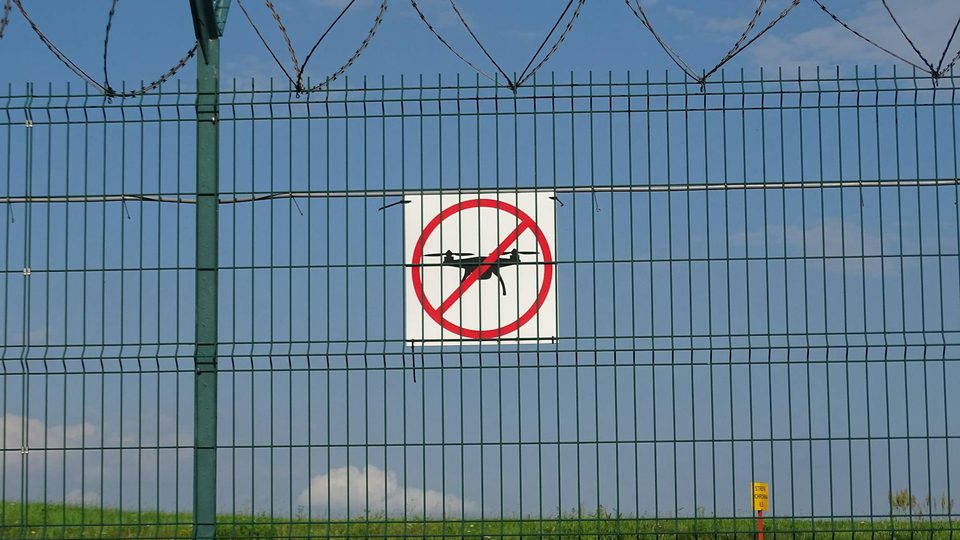
Prison security systems are designed around a tight operating environment where visibility, control, and accountability matter more than broad marketing claims. A correctional facility needs to understand what is happening on the perimeter, around housing units, near service yards, and above the grounds quickly enough to prevent contraband delivery, escape support, or coordinated disruption.
That challenge has become more complex as drones are used to deliver phones, drugs, tobacco, and other prohibited items. U.S. justice and corrections sources now treat unmanned aircraft as a real operational issue, not a speculative one, which means prison security planning increasingly needs to include low-altitude awareness as part of the standard protective architecture.
The Core Problem Is Controlled Visibility
A prison is not an open industrial site. It is a tightly controlled environment with fixed routines, known movement patterns, restricted sight lines, and severe consequences for security failure. The security system therefore has to help staff answer a very specific set of questions:
- is this activity authorized,
- is it linked to the perimeter or an internal area,
- does it suggest contraband delivery or coordination,
- and what must be preserved as evidence.
A Layered Corrections Security Model
The table below is a synthesized planning aid.
| Layer | Main role in a correctional facility | Common weakness |
|---|---|---|
| Perimeter and yard surveillance | Tracks movement near fences, service zones, and likely drop areas | Leaving exterior blind spots where handoffs can occur |
| Drone or RF awareness | Detects low-altitude or wireless indicators tied to contraband delivery | Expecting one sensor type to solve every drone scenario |
| Visual confirmation | Helps staff assess whether an alert is relevant before redeployment | Requiring manual camera search after each alarm |
| Incident management | Preserves timeline, evidence, and chain of escalation | Treating alerts as temporary nuisances instead of prosecutable events |
The DOJ Office of Inspector General audit on BOP UAS mitigation and NIJ material on contraband and drones in correctional facilities both underline the operational reality: drone-enabled contraband is a sustained corrections challenge, and detection must be paired with action and evidence.
Why Alert Quality Matters More Than Alarm Volume
Correctional teams do not benefit from a large number of low-context alerts. Every repositioning of staff changes the security posture elsewhere in the facility. That means the surveillance system has to help the operator decide whether an event is credible, where it is occurring, and what kind of response is justified before resources are moved.
In this environment, false alarms are not just an annoyance. They can consume attention and create gaps.
The Best Systems Support Investigation Too
Prison incidents often become investigative matters. That makes event history, sensor correlation, and evidence retention especially important. A system that only flashes a transient alert but does not preserve location, time, and confirmation data leaves the facility with weak operational follow-through.
Contraband Pathways Should Drive Siting
Correctional facilities gain more value when sensor placement reflects how contraband actually moves. The most important areas are not always the most obvious ones. Staff need to think about likely drop zones, blind areas near the perimeter, service yards, rooflines, recreation spaces, and handoff locations that connect exterior activity to internal movement.
That is why prison security systems should be designed around contraband pathways and response routes, not only around formal perimeter lines. A sensor that technically covers a fence may still miss the spaces where an event becomes operationally relevant.
Command and Evidence Handling Need Discipline
Corrections incidents require clean evidence handling because many events may later support disciplinary, investigative, or prosecutorial action. The monitoring system should therefore preserve:
- time-stamped alert history,
- video or image confirmation,
- location context,
- and operator actions taken during the incident.
If those pieces are fragmented across several consoles or saved inconsistently, the facility loses value after the initial alert even if the detection itself was valid.
Validation Should Follow Daily Operating Reality
Prison environments are structured by predictable routines, but that does not make validation easy. Good testing should include:
- routine movement periods with high background activity,
- nighttime or limited-visibility conditions,
- low-altitude delivery attempts,
- and scenarios where staff must decide whether to redeploy people or continue monitoring remotely.
These conditions reveal whether the system improves control or simply adds noise to an already demanding environment.
Staff Redeployment Has Opportunity Cost
One reason alert quality matters so much in corrections is that moving staff to one incident can weaken supervision elsewhere. A prison security system should therefore be judged partly by whether it reduces unnecessary redeployment and helps staff hold resources in reserve until the event is credible enough to justify action.
The Goal Is Controlled Confidence
The best prison monitoring systems do not try to produce constant intervention. They try to give staff enough confidence to act decisively when needed and enough context to avoid avoidable movement when the event is weak or ambiguous.
Conclusion
Prison security systems should be built around controlled visibility, contraband prevention, and disciplined incident handling. The strongest designs link perimeter watch, low-altitude awareness, and evidentiary workflow so staff can assess events before moving resources and preserve a credible record after the event ends.