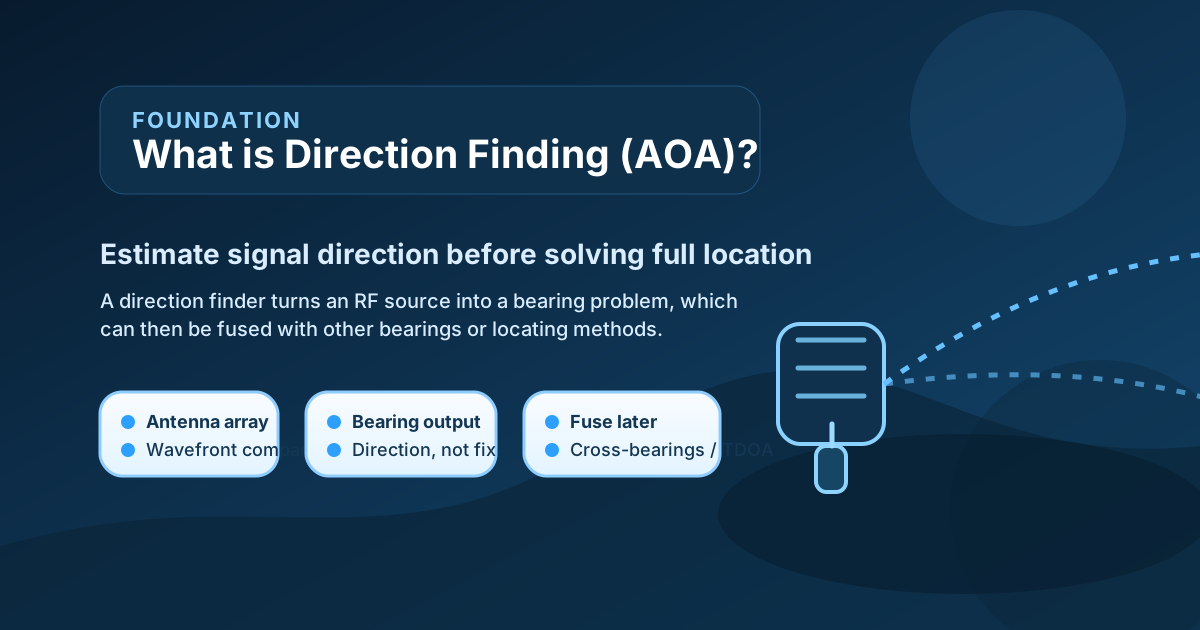
What is direction finding, and what does AOA mean? In simple terms, direction finding is the process of estimating where a radio signal is coming from. AOA stands for angle of arrival. It is one of the most common ways to do that. Instead of asking only whether a signal exists, an AOA-based system asks a more specific question: from which direction did the wavefront reach the sensor?
That makes direction finding useful in several different workflows. Spectrum-monitoring teams use it to hunt down interference. Security teams use it to narrow the search area for an RF emitter or drone controller. A multisensor counter-UAS workflow can use direction information to tell another sensor where to look. In each case, the system is not yet saying “the emitter is exactly here.” It is saying “the emitter is somewhere along this direction.”
That distinction is the beginner key to the whole topic. Many people hear about direction finding and assume the system immediately knows the full location of the transmitter. Usually that is not true. One bearing is not a full map position. One bearing gives a line of possible origin. To turn that into a location, the system often needs multiple bearings, multiple sites, motion over time, or another locating method such as TDOA.
Rohde & Schwarz describes AOA direction finding as measuring the incoming wavefront angle, and its geolocation material makes the same point from a systems perspective: AOA and TDOA are different locating methods with different strengths, and they are often combined because they complement one another. So the stable beginner idea is this: direction finding is about direction first, not perfect position first.
What Direction Finding Actually Produces
The cleanest mental model is to think in terms of a bearing.
A direction finder listens to an incoming signal and estimates the azimuth or direction of arrival relative to the antenna system. The output is often expressed as:
- a compass bearing,
- an azimuth angle,
- or a direction line drawn from the sensor site outward on a map.
That is useful because it immediately reduces uncertainty. Instead of a 360-degree search problem, the operator now has a sector or line to investigate. In a practical system, that line may then be fused with:
- another direction finder at a different site,
- another bearing taken from a different time or position,
- a radar or optical cue,
- or a TDOA result.
This is why beginners should separate three different ideas:
detection: a signal is present,direction finding: the signal is arriving from a particular direction,geolocation: the system estimates the emitter’s actual position.
Those three steps are related, but they are not interchangeable. A strong RF workflow often uses all three, but it does not get all three from the same measurement every time.
How AOA Works
AOA methods depend on antenna geometry and signal comparison. Different systems implement this in different ways, but the common principle is that the incoming wave reaches different antenna elements with slightly different phase, amplitude, or timing relationships. The system compares those differences and uses them to estimate the signal direction.
At a beginner level, the logic can be understood in four steps:
- A signal arrives from the air.
- The wavefront reaches an antenna or antenna array.
- The system compares how the signal appears across the receiving elements.
- From that comparison, the processor estimates a bearing.
The exact math varies with the antenna design and algorithm. Some systems emphasize phase comparison. Others use interferometry or super-resolution techniques. Some are optimized for broad spectrum-monitoring use, while others are designed for faster tactical direction finding. But the overall concept stays the same: the system learns direction by exploiting how the same signal looks slightly different across a designed sensor geometry.
Rohde & Schwarz describes the R&S DDF260 as combining a monitoring receiver with accurate AOA direction finding, which is a useful clue for beginners. A direction finder is not only an antenna on a mast. In modern systems, it is usually a measurement chain made of antenna hardware, receiver performance, signal processing, and calibration.

Figure: Synthesized explainer showing the beginner mental model for AOA direction finding: incoming signal, antenna array, signal comparison, and output bearing line.
This is also why one badly framed beginner question can cause trouble. Asking “how accurate is AOA?” without asking about the antenna, frequency, site, and signal environment is not very meaningful. The answer depends on the whole chain, not only the algorithm label.
One Bearing Is Not a Full Location
This point deserves its own section because it is where most early misunderstanding begins.
An AOA result from one site usually tells you the direction of the emitter from that site. On a map, that means the emitter could be somewhere along the bearing line. The system has narrowed the problem, but it has not closed it.
There are several common ways to narrow it further:
- take another bearing from a second site and look for the intersection,
- move the sensor and take bearings over time,
- combine AOA with another locating method,
- or fuse the bearing with contextual information such as known roads, flight corridors, or visually observed targets.
This is why direction finding is so often part of a system rather than a standalone answer. AOA is powerful because it gives fast directional information. But the strongest operational result usually comes when that direction is fused with other measurements.
Rohde & Schwarz’s hybrid geolocation material explains exactly this complementarity. TDOA tends to be strongest when receivers surround the emitter. Direction finders can still determine the locations of outlying emitters more flexibly. That is one reason operators combine them. AOA is not being replaced by other methods. It is being used where its geometry and workflow make sense.
What Changes AOA Accuracy
Beginners often want one single accuracy number. In practice, several factors change how useful the bearing really is.
Signal-to-Noise Ratio
If the signal is weak relative to the noise floor, the measurement becomes less stable. The hybrid AOA/TDOA white paper from Rohde & Schwarz makes the point directly: higher signal-to-noise ratio supports better achievable geolocation accuracy. That logic matters for AOA as much as for broader RF locating workflows.
Multipath and Reflections
Urban environments, metal structures, vehicles, and buildings can reflect signals. That means the sensor may not receive only the direct path. It may receive multiple versions of the same signal from different directions. This can bend or blur the bearing estimate and is one of the major reasons field accuracy differs from ideal test conditions.
Antenna Aperture and Calibration
AOA performance depends on the antenna system being designed and calibrated for direction finding. Array geometry, element consistency, phase stability, and calibration discipline matter. A system that is not well aligned can produce a clean-looking but less trustworthy bearing.
Frequency and Waveform Behavior
Not every signal behaves the same way. Bandwidth, modulation, duty cycle, burst behavior, and frequency range all shape how well the system can measure and interpret the signal.
Site Geometry
Where the direction finder sits matters. Height, obstacle clearance, and site placement affect whether the sensor sees the emitter directly or through a reflected environment. Good geometry can make the bearing far more useful than the same hardware placed in a cluttered blind spot.
How the Bearing Is Used
A bearing that is not highly precise can still be operationally useful if it points another sensor to the correct sector quickly. On the other hand, a workflow that expects map-grade closure from a single bearing will often be disappointed. Accuracy is not only a property of the sensor. It is also a property of the decision task.

Figure: Synthesized factor map showing why bearing usefulness depends on signal quality, multipath, antenna design, site placement, and workflow expectations.
AOA vs TDOA vs Geolocation
It helps to keep these terms separate.
AOA is a method for estimating direction.
TDOA is a method for estimating location from arrival-time differences across multiple receivers.
Geolocation is the broader task of estimating where the emitter actually is.
Rohde & Schwarz’s hybrid geolocation material explains why operators often combine AOA and TDOA rather than choosing one forever. TDOA can give very strong results when receiver placement surrounds the emitter. AOA remains useful where direction-finding stations can better handle outlying emitters or where operators want direct bearing-based cueing. The combination can improve coverage and reduce the weaknesses of relying on only one method.
That is the practical lesson for beginners. AOA is not a competitor to all other locating methods. It is one important locating ingredient. In some workflows it is the first directional step. In others it is part of a hybrid fix. In still others it mainly helps with cueing and narrowing the search space.
Common Misunderstandings
Several mistakes appear again and again.
“Direction finding gives the exact location immediately”
Usually no. One AOA result normally gives a direction, not a finished position.
“A bearing line is the same as proof”
No. A bearing is a useful clue, but it still needs interpretation, confirmation, or fusion with other measurements.
“If the system sees RF, the bearing will always be clean”
No. Reflections, weak signals, interference, and poor site placement can all distort the result.
“AOA makes TDOA unnecessary”
No. These methods often complement each other. One reason hybrid systems exist is that no single method dominates every environment.
“Direction finding is only for interference hunting”
No. It is also useful in security, spectrum monitoring, counter-UAS workflows, and any RF task where narrowing the source direction has value.
What This Means in Practice
For a beginner, the best mental model is this: AOA turns an unknown RF source into a directional problem.
That alone can be highly valuable. If an RF detector tells you a control link or emitter exists, direction finding can tell you where to focus attention. If you add a second site, a mobile sensor, or another locating method, the result becomes more specific. This is why AOA often sits between raw RF detection and full geolocation in a practical workflow.
It also changes how you should read product claims. A good question is not only “what is the nominal bearing accuracy?” A better set of questions is:
- in what band and signal environment,
- with what antenna and calibration,
- from what site geometry,
- and for what operational decision?
Those questions better reflect how direction finding is actually used.
Conclusion
Direction finding is the process of estimating where a radio signal is coming from. AOA is one of the most common ways to do it, using antenna geometry and signal comparison to produce a bearing. That bearing can dramatically reduce uncertainty, but it is usually not the same as a full emitter position.
The key takeaway is simple: AOA is a directional layer, not magic location certainty. Its real value comes from how well it is calibrated, how clean the signal environment is, and how effectively the bearing is fused with other sensors or measurements in the larger workflow.