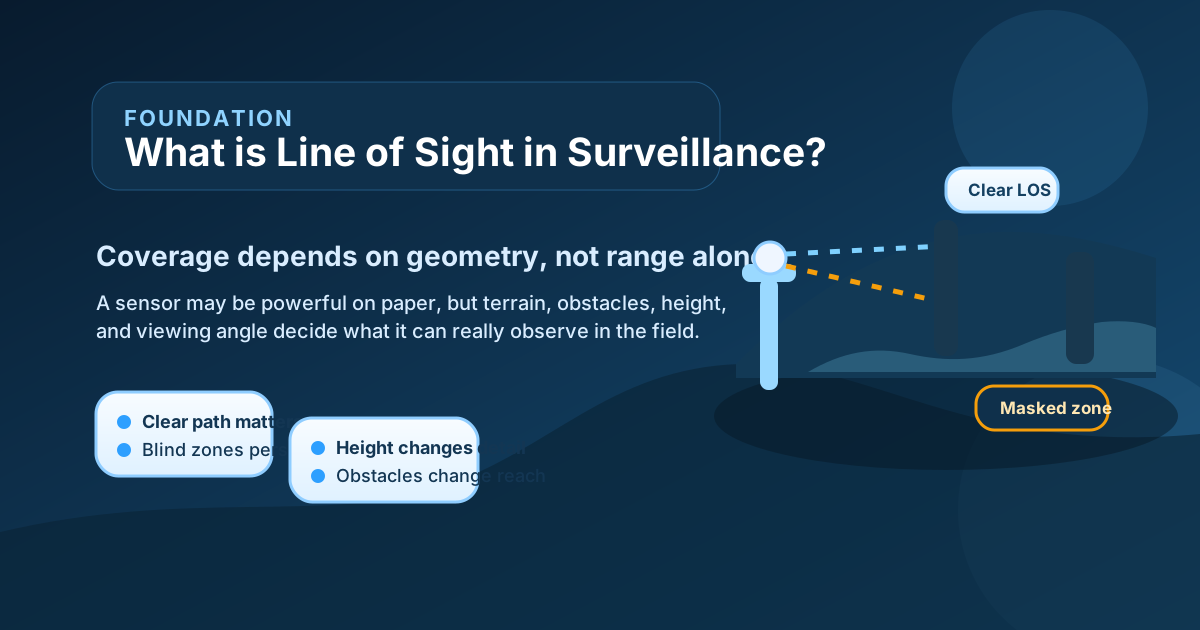
What is line of sight in surveillance? In plain language, line of sight, usually shortened to LOS, means the sensor has a usable direct path to the part of the scene it needs to observe. If a hill, building, wall, tree line, container stack, or even the Earth’s curvature blocks that path, then the target may be inside the system’s theoretical range and still not be seen in practice.
That is why line of sight is one of the most important ideas for beginners to understand. People often focus on advertised sensor range, optical zoom, or camera resolution and assume those numbers tell the whole story. They do not. A camera with excellent zoom still cannot see through a warehouse corner. A radar with strong detection range still has blind sectors created by terrain masking or low-altitude geometry. A thermal camera can improve contrast at night, but it still needs a path to the target area. In real deployments, line of sight often determines whether the sensor is useful more than the headline specification does.
The concept also matters outside fixed security sites. FAA rules for unmanned aircraft operations use visual line of sight as a safety concept because if the remote pilot cannot directly keep the aircraft in sight, awareness and control risk change. Axis makes a similar practical point in a different context in its mounting-height guidance: mounting geometry affects coverage, blind spots, and image detail. These examples come from different fields, but they teach the same beginner lesson. Observation is not just about capability on paper. It is about geometry in the real world.
So the short answer is simple: line of sight is the physical and geometric condition that allows the sensor to observe the target area. But the practical meaning is broader. LOS is really about whether the sensor is placed where it can deliver useful awareness, not merely where it fits on a drawing.
What Line of Sight Actually Means
At the simplest level, line of sight means that nothing important is blocking the observation path between the sensor and the target.
For a person standing on a hill, that idea feels intuitive. If a building is between the observer and the target, the target disappears. The same idea applies to surveillance systems, although each sensing technology experiences LOS in a slightly different way.
For visible cameras, LOS is very direct. The camera needs a clear optical path to the subject. A wall, a truck, a hill crest, or a stand of trees can hide the target completely.
For thermal cameras, the same basic rule applies. Thermal imaging may help in darkness, glare, or some haze conditions, but it still does not remove solid obstacles from the scene. If the target is behind a concrete barrier or fully hidden by terrain, the thermal imager does not magically restore a view.
For surveillance radar, the story is a little more nuanced, but LOS still matters. Radar can see in darkness and through some conditions that trouble visible cameras, yet low-altitude targets remain strongly affected by terrain masking, buildings, local clutter, and horizon geometry. A radar data sheet may list a long detection range, but a site with uneven ground and tall structures can cut the usable coverage sharply.
For RF sensing, LOS is not identical to optical LOS, but geometry still matters. Buildings, shielding, reflections, and antenna placement all affect what the receiver can hear and from which direction the system can estimate the signal. So even when the sensing mechanism differs, placement and path geometry still shape real performance.
This is why LOS should not be treated as a camera-only concept. It is a planning concept for almost every surveillance architecture.
How LOS Works in a Real Site
The easiest way to understand LOS is to imagine a straight observation path from the sensor to the target area.
If that path stays clear enough for the sensor to observe what matters, then line of sight is good. If the path is blocked, clipped, or degraded by the environment, then LOS is weak or lost.
Several common situations reduce LOS:
- a camera mounted too low behind parked vehicles,
- a radar placed where nearby roofs create masking,
- a shoreline camera whose view is interrupted by cranes or masts,
- a perimeter sensor whose fence line curves behind vegetation,
- or a rooftop installation whose near blind zone hides activity close to the building.
In practice, LOS is often about more than one point. A surveillance team usually wants line of sight across an area, route, sector, approach lane, or perimeter edge. That means coverage planning needs to ask not only “Can the sensor see this one location?” but also “Which parts of the area become hidden, shallow-angle, or weak-confidence zones?”

Figure: Synthesized explainer showing how clear and blocked observation paths create usable coverage and shadow zones in a surveillance layout.
This is where site drawings can be misleading. On a flat 2D map, two points may look connected. In the real world, roofs, walls, grade changes, and near-field blind spots may break that connection. LOS therefore has to be judged in three dimensions, not only by distance on a plan view.
Why LOS Matters More Than People Expect
Beginners often assume that if the system is powerful enough, LOS becomes a secondary concern. Usually the opposite is true. The more a system depends on long range, narrow field of view, or accurate classification, the more important LOS becomes.
Consider a PTZ or EO/IR camera. Long zoom can be very valuable, but it also narrows the field of view and increases sensitivity to small pointing errors. If the sensor is mounted where obstacles cut across the intended viewing corridor, the extra zoom does not solve the real problem.
Consider radar. A radar may be able to detect a target many kilometers away in open conditions, yet the actual site may contain terrain shelves, building lines, towers, or tree canopies that create masked sectors. A buyer who looks only at the catalog range may overestimate what the installed system can actually observe.
Consider perimeter security. A fence may appear fully covered by a set of cameras or radars, but the real geometry may leave:
- dead ground near the base of a pole,
- hidden corners around structures,
- shallow-angle views that reduce useful image detail,
- or short sections where an intruder can move through clutter without clear observation.
Axis highlights this practical relationship in its mounting-height guidance by showing how mounting height changes vertical coverage, pixel density, zoom angle, and even the blind spot directly beneath the camera. That is a good beginner lesson because it shows that LOS is not only about far range. Near geometry matters too.
This is also why the FAA’s use of visual line of sight in drone operations is a helpful analogy. The rule is not about making the operation harder for no reason. It reflects the simple reality that awareness depends on maintaining a usable observation path. When the observer cannot maintain that path, risk rises because the picture of the aircraft’s position and movement becomes less reliable.
What Changes Real Line-of-Sight Quality
Line of sight sounds like a yes-or-no idea, but in real surveillance it is often a quality problem as well as a blocking problem.
Mounting Height
Height is one of the strongest variables. A higher mounting point can open the view over walls, vehicles, or vegetation. But higher is not automatically better. As Axis notes, increasing height changes pixel density and zoom angle, and it also changes the blind spot close to the installation. A high mount may improve area coverage while reducing useful detail or creating awkward near-field geometry.
Terrain and Surface Geometry
A site is rarely perfectly flat. Small ridges, embankments, drainage channels, berms, ramps, and shoreline contours can all create observation gaps. These are easy to miss on a simplified site plan.
Buildings, Vegetation, and Temporary Obstacles
Permanent structures obviously affect LOS, but temporary conditions matter too. Parked trucks, stacked pallets, containers, event stages, and maintenance equipment can change what the system sees from one week to the next.
Target Height
A person on foot, a vehicle, a mast, and a low-flying drone all occupy different heights. A sensor that has LOS to a truck roofline may not have LOS to a crouched person beside a barrier. A radar that sees a higher aircraft well may struggle more with very low targets masked by local features.
Field of View and Viewing Angle
A sensor can technically see the target but still not see it well enough to support the task. A steep angle, shallow angle, or highly oblique view may reduce useful detail, recognition, or interpretation. LOS is therefore not only “can I see it?” but also “can I see it well enough to do the job?”
Range and Horizon Effects
At longer distances, Earth’s curvature and local horizon effects matter more. This is especially important for coastal, maritime, or long-corridor surveillance. A site may have nominal range on paper while the actual low-altitude or low-surface target disappears below the usable observation geometry.
Atmosphere and Visual Clutter
Even with a nominally clear path, haze, glare, rain, heat shimmer, smoke, and heavy background clutter can reduce practical LOS quality. A visible camera, thermal camera, and radar will each respond differently, but none are fully independent from the environment.

Figure: Synthesized factor map showing why line-of-sight quality depends on mounting height, terrain, obstacles, target height, viewing angle, range, and atmosphere.
The beginner takeaway is that LOS should be treated as a system-geometry question. Distance alone does not describe it well enough.
LOS Is Not the Same for Every Sensor
This distinction matters because many sites use layered sensing.
A visible camera needs a clear optical view and enough light or contrast. A thermal camera still needs a clear path, but it may preserve contrast better at night or in some degraded visual conditions. Radar does not depend on visible light, yet terrain masking and low-altitude geometry remain critical. RF sensing may detect signals from areas that a camera cannot directly see, but buildings and shielding still shape how well the system hears and locates those signals.
This means LOS should be evaluated by sensor role:
- search,
- verification,
- tracking,
- identification,
- or response support.
A site may use radar to retain broader search awareness while EO/IR systems handle visual verification where optical LOS is good. Another site may rely on several shorter-range cameras because the architecture and terrain make one long-range viewpoint unreliable. LOS planning is therefore closely tied to sensor fusion. Different sensors help cover different geometry weaknesses.
Common Mistakes
Several LOS mistakes show up again and again.
“If the target is inside range, the sensor can see it”
No. Range is not the same as visibility. Obstacles and geometry can break the observation path long before nominal range is reached.
“Higher is always better”
No. More height can improve coverage, but it can also reduce image detail, worsen close-in blind zones, and create less useful view angles for some tasks.
“A 360-degree camera or rotating radar has no blind spots”
No. Rotation does not remove terrain, structures, or near-field masking.
“One site survey is enough forever”
No. Construction changes, seasonal vegetation, container placement, vehicle patterns, and mission changes can all alter LOS over time.
“Line of sight guarantees good identification”
No. LOS is necessary for many tasks, but image detail, contrast, stability, and target behavior still determine whether the operator can actually identify or classify what is seen.
What This Means in Practice
For a beginner, the most useful mental model is this: line of sight is the geometry that makes surveillance real.
If you are planning or evaluating a site, good questions include:
- where are the masked zones,
- what happens close to the sensor,
- how do height and angle change useful detail,
- which target heights matter most,
- what seasonal or temporary obstacles appear,
- and which sensor layers compensate for one another?
These questions are usually more valuable than asking only for maximum detection range or maximum zoom.
This also explains why mature surveillance design often uses layered sensing rather than one perfect viewpoint. Cameras, thermal imagers, radar, and RF sensors each experience LOS limits differently. A well-designed system uses that diversity to reduce geometry-driven blind spots.
In other words, line of sight is not a minor installation detail. It is part of the architecture. If the geometry is wrong, even a technically capable sensor may underperform. If the geometry is right, a more modest sensor may become far more effective than the specification sheet alone would suggest.
Conclusion
Line of sight in surveillance means the sensor has a usable observation path to the target area without blocking terrain, structures, or other geometry problems. It sounds simple, but it controls whether range, zoom, resolution, and other specifications turn into real performance.
The key takeaway is that LOS is a geometry problem before it is a specification problem. Mounting height, obstacle placement, target height, viewing angle, and horizon effects all shape what the system can truly observe. A site that understands line of sight well can design coverage more honestly, reduce blind spots, and choose sensor layers that work together instead of relying on paper range alone.