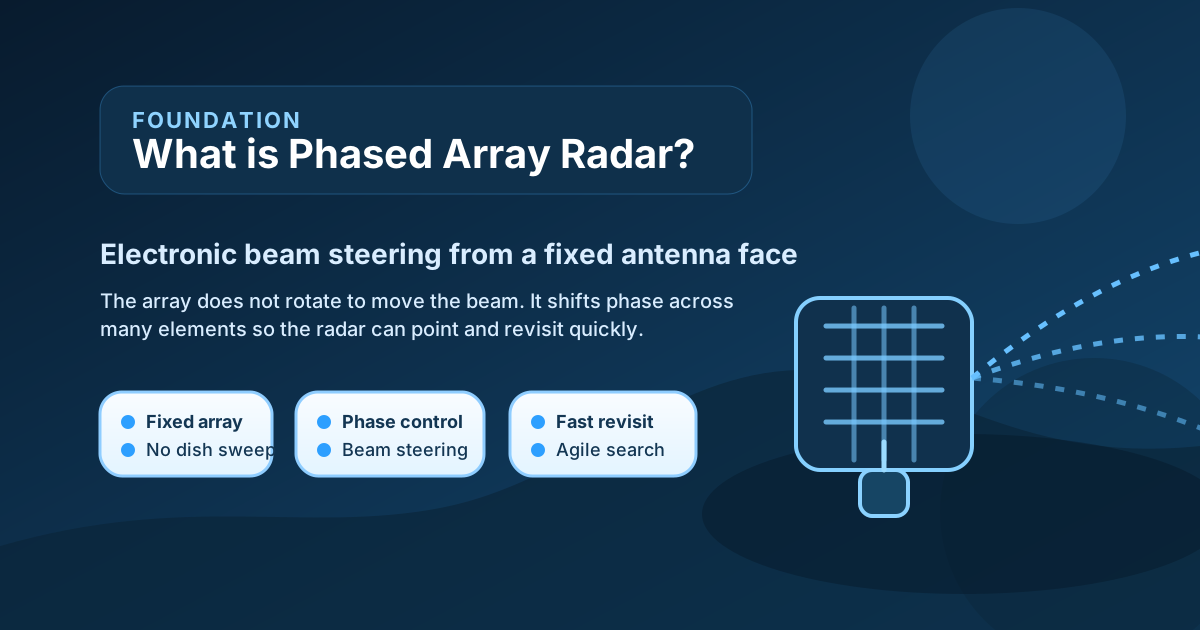
What is phased array radar? In simple terms, it is a radar that steers its beam electronically by controlling many antenna elements, rather than steering the beam mainly by rotating or tilting the whole antenna mechanically. That is the defining idea. The radar face can remain fixed, but the beam can still be pointed in different directions.
For beginners, this is the key contrast to remember. A conventional mechanically scanned radar usually points the beam by physically turning the antenna. A phased array radar points the beam by changing the relative phase of signals across an array of elements. NOAA’s phased array radar explanations describe this directly: the antenna remains stationary while the beam can be steered electronically left-to-right and up-and-down.
That change matters because beam steering is not just a geometry detail. It changes how fast the radar can revisit an area, how selectively it can focus on different sectors, and how flexibly it can support different tasks. This is why phased array radar is discussed so often in weather observation, air surveillance, missile defense, and other applications where timing and adaptable scanning matter.
What Makes a Radar “Phased Array”
The phrase phased array refers to the antenna architecture.
Instead of one rotating dish or one mechanically swept beam source, the radar uses many radiating elements arranged in an array. Those elements are controlled so that the outgoing and incoming wavefronts reinforce one another in selected directions. By changing the relative timing or phase across the array, the radar shapes and points the beam.
This is why phased array radar is often associated with a flat panel rather than a dish. NOAA’s National Severe Storms Laboratory explains that a phased array radar has a unique flat panel antenna made up of a grid of fixed antenna elements, each able to transmit and receive a signal. Because the array is electronically controlled, the radar can steer the beam without mechanically rotating the antenna face in the same way a traditional radar does.
At a beginner level, you do not need the full antenna theory to understand the main operational result. The array behaves like a controllable aperture. Instead of waiting for a motor to rotate the beam into place, the system can change beam direction by electronic control.
How Electronic Beam Steering Works
The beam-steering idea sounds abstract until it is stated plainly.
Each array element contributes part of the total transmitted or received signal. If the radar changes the relative phase relationship among those elements, the combined wavefront is reinforced more strongly in one direction and reduced in others. The result is a beam that points where the control logic wants it to point.
A NOAA primer on phased array radar technology states that the main lobe of a phased array can be electronically steered to different angles by varying the phase progression across the array. That sentence captures the essence of the mechanism. The beam is not moved by mechanical rotation. It is redirected by coordinated control of the array.

Figure: Synthesized explainer showing how a fixed antenna face can steer the beam by changing element timing and phase across the array.
This is also why phased array radar can support faster directional changes than a purely mechanical scan. The radar does not have to wait for the entire antenna assembly to physically swing back to a new look angle. That does not mean every phased array can look everywhere instantly with no constraints, but it does mean the beam-control method is fundamentally different.
Why Phased Array Radar Matters
The practical value of phased array radar comes from what electronic steering enables.
NOAA’s weather-radar material emphasizes that electronic steering lets users control how, when, and where the radar scans. It also notes that the radar can focus observations on storms rather than wasting time scanning clear-air regions. That weather example is useful because it shows the broader principle: the radar can spend more attention where the mission needs it.
In a beginner-friendly list, the main advantages are:
- faster revisit of important sectors,
- more flexible scan scheduling,
- the ability to prioritize targets or regions of interest,
- and less dependence on moving the whole antenna structure for every beam change.
This is why phased array radar is attractive in missions where update speed matters. If conditions are changing quickly, or if several tasks compete for radar time, electronic steering can create a more agile observation cycle. In some applications that means faster weather updates. In others it means better target tracking, more adaptable surveillance, or easier support for multiple simultaneous mission needs.
Phased Array Radar Is Broader Than AESA
Beginners often hear phased array radar and AESA together and assume they mean exactly the same thing. They do not.
Phased array is the broader architectural idea: an array of elements is used to steer the beam electronically. AESA, or active electronically scanned array, is one important type within that broader family. In an AESA, many transmit/receive functions are distributed more actively across the array. But not every phased array discussion is automatically about a fully active array architecture.
This distinction matters because a beginner can otherwise miss the family tree:
phased array radaris the umbrella concept,PESAandAESAare different ways of implementing electronically scanned arrays,- and the performance, cost, and flexibility can vary across those implementations.
So if someone asks what phased array radar is, the safest starting answer is not “it means AESA.” The safer answer is “AESA is one important kind of phased array radar.”
Why It Can Scan Faster Than Mechanical Radar
One of the biggest operational differences between phased array and mechanical scanning is time allocation.
A mechanically scanned radar often follows a repeating physical motion pattern. If the radar needs to look back at one sector, it may have to wait for the mechanical scan cycle or spend motion time returning there. A phased array can often redirect attention more selectively because beam motion is electronic rather than purely mechanical.
This does not mean the entire radar problem disappears. Dwell time, energy management, signal processing, thermal load, and field-of-view limits still matter. But electronic steering usually gives the radar designer a more agile way to spend the available scan time.
That is why NOAA materials on phased array radar talk about faster updates and focused observations. The benefit is not only raw speed in isolation. It is control over where time and energy are spent.
What Changes Performance
Several practical factors shape how useful a phased array radar becomes.
Array size and element count
The number of elements and the physical size of the array influence beam shape, gain, and steering capability. NOAA’s Advanced Technology Demonstrator, for example, is described as using 76 panels and 4,864 radiating elements. Beginners do not need to memorize those numbers, but they do need to understand the principle: the array itself is a major part of the performance story.
Steering angle and field of view
Electronic steering is powerful, but it is not unlimited. Array geometry and steering angle constraints affect how far off broadside the beam can be pushed before performance penalties become more serious.
Power, cooling, and calibration
As arrays become more capable, the system also has to manage more electronics, more synchronization, and often more heat. Fast beam control is attractive, but it brings engineering demands in calibration, maintenance, and thermal design.
Mission design
A phased array built for weather observation is not identical to one built for air defense or site surveillance. The value of electronic steering depends on what the radar is supposed to prioritize: wide-area search, targeted revisit, track maintenance, multifunction operation, or some combination of these.
Common Misunderstandings
Several beginner misconceptions show up repeatedly.
“Phased array means the antenna moves very fast”
No. The main idea is the opposite. The beam direction can change even when the array face stays stationary.
“Phased array radar means AESA, and nothing else”
No. AESA is one important subtype, but phased array is the broader architectural concept.
“Electronic steering means the radar can do everything at once”
No. Even a very capable phased array still has to manage dwell time, energy, scheduling, and task priorities. Electronic steering improves agility, but it does not remove all resource limits.
“If the array is flat, the radar must automatically have 360-degree coverage”
No. Coverage depends on the system design. A single fixed panel does not automatically see in every direction at full performance.
“Phased array is only about speed”
Not quite. Speed matters, but the bigger advantage is often scan control. The radar can put its attention where the mission needs it rather than spending all of its time on a rigid mechanical cycle.
What This Means in Practice
For a beginner, the most useful mental model is that phased array radar changes how the radar spends its attention.
Instead of depending mainly on mechanical movement to point the beam, the radar can redirect the beam electronically. That can improve revisit speed, targeted scanning, and flexibility in dynamic environments. This is why phased array radar is often associated with missions where conditions change quickly or where several observation tasks must be balanced at once.
It also explains why phased array radar is not automatically the right answer for every job. The architecture can bring real gains, but it also brings cost, complexity, calibration demands, and coverage trade-offs that depend on the design. So the right beginner conclusion is not “phased array is always better.” The better conclusion is “phased array changes the scanning model, and that matters when timing and flexibility matter.”
Conclusion
Phased array radar is a radar architecture that steers the beam electronically through many controlled antenna elements. The array face can remain stationary while the beam is redirected by phase control across the array.
That matters because the radar can revisit important areas faster and spend its scan time more selectively than a purely mechanical system. The concept is broader than AESA, and its benefits come with real engineering trade-offs. But at a beginner level, the main idea is simple: phased array radar changes beam steering from a mechanical problem into an electronic one.