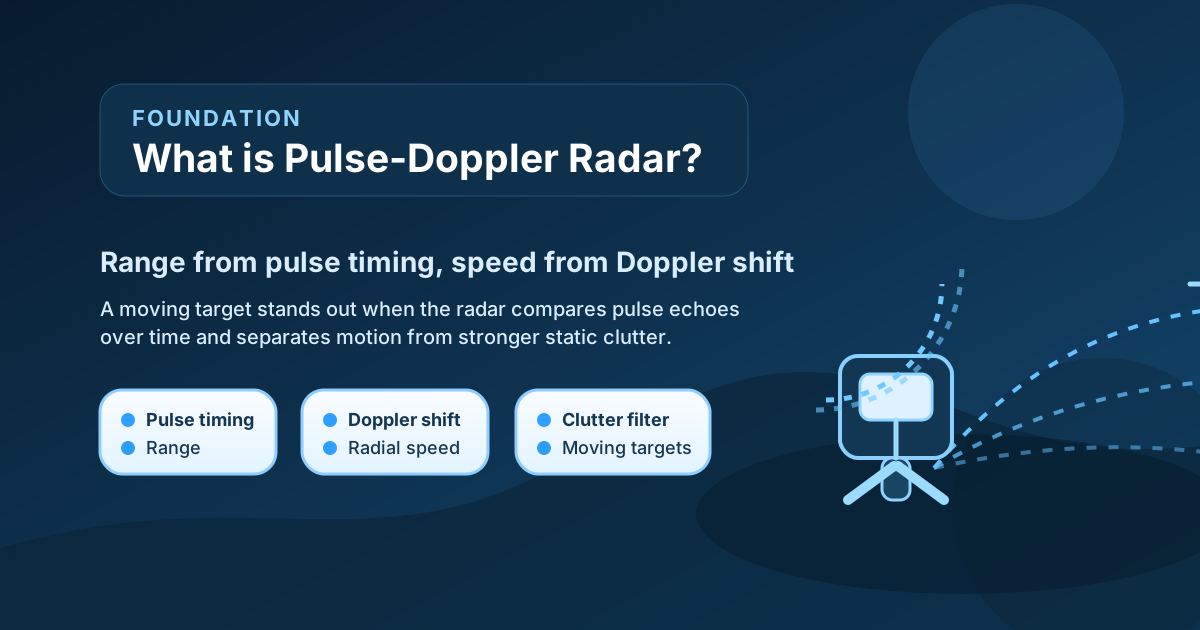
What is pulse-Doppler radar? In simple terms, it is a radar that uses short pulses to measure target range and also uses Doppler information to estimate whether a target is moving toward or away from the radar. That combination is what makes the term important. A pulse radar can tell you where an echo came from by timing how long the signal takes to return. A Doppler-capable radar adds another layer by looking at the phase or frequency change associated with motion.
For a beginner, the easiest mental model is this: pulse tells the radar how far away the target is, while Doppler helps tell the radar whether the target is moving relative to the radar. When those two ideas work together, the radar becomes much more useful in messy real environments, especially when it needs to separate moving targets from clutter such as terrain, buildings, ground reflections, rain, or other unwanted returns.
That is why pulse-Doppler radar appears so often in surveillance, weather observation, air defense, and moving-target tracking. It is not because the phrase sounds advanced. It is because the combination solves a practical problem. A radar that only knows there is an echo somewhere may still struggle in a cluttered scene. A radar that can connect range with radial motion has a better chance of deciding which returns matter.
What the Name Pulse-Doppler Actually Means
The name comes from two different radar ideas joined together.
The first idea is pulse radar. A pulse radar does not transmit continuously. It sends very short bursts of radio energy, then listens for the echo. If the radar knows when the pulse left and when the echo came back, it can estimate the target’s range from the travel time.
The second idea is Doppler. The Doppler effect appears when motion changes the observed frequency or phase relationship of a wave. In radar, this is useful because a target moving toward or away from the radar changes the returning signal in a measurable way. NOAA weather-service explanations describe Doppler radar as a radar that can detect motions toward or away from the radar as well as the location of targets. That is the beginner-level definition worth remembering.
When people put the two words together, they mean a radar architecture that uses pulse timing for range and Doppler processing for radial motion. The result is not simply “better radar.” It is a radar that is better at answering a richer operational question: not only where the target is, but whether it is moving in a way that makes it relevant.
How Pulse and Doppler Work Together
The core mechanism is easier than the name makes it sound.
First, the radar sends a pulse. Then it waits for the echo to return. The time delay between transmit and receive tells the radar how far away the reflector is. This is the basic ranging function of pulsed radar.
Then the radar compares successive returns in a way that reveals motion relative to the radar. Public NOAA material on Doppler weather radar explains that the system tracks the phase of the transmitted pulse and measures the phase shift between the transmitted pulse and the received echo. That shift is used to calculate radial velocity, meaning motion directly toward or away from the radar.
An older but still useful NOAA engineering report on a pulse-Doppler X-band radar describes the system as phase coherent and explains that it measures the rate of change of the phase of the target reflection relative to the transmitter phase. That is the technical core in plain language: the radar is not only checking whether the echo came back. It is checking how the echo relationship changes from pulse to pulse.

Figure: Synthesized workflow showing how a pulse-Doppler radar uses pulse timing for range and pulse-to-pulse comparison for radial velocity.
This combination matters because a radar environment is usually full of returns that are physically real but operationally unimportant. A pulse-Doppler system can use motion information to reduce attention on static or slow clutter and emphasize targets that are moving in meaningful ways.
What Pulse-Doppler Radar Can Measure
A pulse-Doppler radar can support several kinds of output, depending on system design, waveform choices, processing quality, and antenna behavior.
At a beginner level, the most important outputs are:
range, which comes from pulse timing,bearingor angular direction, which comes from the antenna pointing geometry,echo strength, which can help describe target return quality,- and
radial velocity, which comes from the Doppler part.
That last term needs care. Radial velocity does not mean full target speed in every direction. It means the component of motion toward or away from the radar. If a target is moving sideways relative to the radar, the measured radial velocity may be small even though the target is moving quickly in real space. This is one of the most important beginner limits to understand.
In weather radar, this helps explain why Doppler products show inbound and outbound motion relative to the radar site rather than a full 3D wind field by magic. In surveillance radar, it explains why motion interpretation works best when the radar geometry, scan design, and tracking logic are all considered together.
Why Pulse-Doppler Radar Matters in Clutter
The real value of pulse-Doppler radar often appears when the background is complicated.
Imagine a radar looking over terrain, buildings, vegetation, or sea surface reflections. Many echoes may come back strongly even when no moving target of interest is present. A basic pulse radar can still measure those returns, but the operator or software may have a harder time deciding which returns matter most.
Pulse-Doppler radar helps because moving targets often produce a motion signature that differs from the background. That makes it easier to separate a moving aircraft, drone, vehicle, or weather feature from stationary or slowly varying clutter. This does not mean clutter disappears. It means motion becomes another useful filter for deciding what deserves attention.
That is one reason the technology became so important in weather applications. NOAA weather-radar explanations point out that Doppler radar can provide information about both target position and movement. In a weather context, this means forecasters can see not only where precipitation is, but also how the air within the storm is moving relative to the radar. In a surveillance context, the same logic helps distinguish moving targets from the surrounding scene.
Figure: Synthesized comparison showing why motion-sensitive processing helps a radar focus on moving targets rather than treating every echo as equally important.
Pulse-Doppler Radar Is Not the Same as Any Doppler-Labeled Product
Beginners sometimes hear the word Doppler and assume every Doppler radar is the same. That is too broad.
The word Doppler only tells you that motion-related information is being extracted from the signal. It does not, by itself, tell you the exact waveform, antenna design, frequency band, software stack, target class, or mission. A pulse-Doppler air-surveillance radar, a weather Doppler radar, and a short-range drone-detection radar may all rely on Doppler principles, but they are not identical systems.
The same caution applies in reverse. Not every pulsed radar uses Doppler processing in the same way or to the same depth. Some systems emphasize search. Some emphasize weather products. Some emphasize target discrimination, tracking, or clutter rejection. The shared beginner idea is the combination of pulsed ranging with motion-sensitive processing, not one universal machine design.
What Changes Performance
Several design choices affect how well a pulse-Doppler radar works in practice.
Pulse repetition behavior
The radar has to choose how often pulses are transmitted and how the receive timing is organized. This affects the balance between range measurement, velocity measurement, and ambiguity handling. At a beginner level, the key lesson is simple: the radar cannot optimize every variable without trade-offs.
Coherence and processing quality
Pulse-Doppler processing depends on stable comparison between pulses. If the system is not sufficiently phase coherent, the motion estimate becomes less useful. This is why technical descriptions of pulse-Doppler systems often emphasize coherence, oscillator stability, and signal processing.
Antenna geometry and scan behavior
The radar still needs a sensible view of the target. Angular coverage, scan rate, revisit rate, and line of sight all affect what the system can measure and how reliable its tracks will be.
Target and clutter environment
A moving target against open sky is a different problem from a small target close to terrain, sea clutter, or dense urban reflections. Pulse-Doppler processing helps, but it does not make geometry and background conditions irrelevant.
Common Misunderstandings
Several beginner misunderstandings appear again and again.
“Pulse-Doppler radar tells you everything about target motion”
No. By itself, it tells you radial motion, which is the toward-or-away component relative to the radar. Full motion understanding usually needs tracking over time, geometry, or multiple sensing inputs.
“If a radar is pulse-Doppler, clutter is no longer a problem”
No. Clutter is still a real issue. Pulse-Doppler processing improves separation of moving targets from background returns, but it does not eliminate difficult environments, poor placement, or bad geometry.
“Pulse-Doppler is only for military radar”
No. The concept appears in weather radar, civil surveillance, and many non-military sensing contexts. The use case changes, but the underlying signal logic remains important across domains.
“Doppler only matters for speed”
Not quite. Speed estimation is important, but the bigger operational value is often classification and filtering. Motion information helps the radar decide which echoes deserve more attention.
“A pulse-Doppler radar automatically identifies the target”
No. It helps with range and motion-based interpretation. It does not automatically prove target identity, intent, or authorization.
What This Means in Practice
For a beginner, the most useful takeaway is that pulse-Doppler radar is built to reduce ambiguity in a dynamic scene.
If you only know where echoes are, you still have a sorting problem. If you know where echoes are and which ones show meaningful radial motion, you can make better decisions about search, tracking, and operator attention. That is why pulse-Doppler radar is so often associated with moving-target detection rather than simple echo display.
It also explains why the concept appears across different radar families. Weather systems use it to see movement inside storms. Surveillance systems use it to help find and track moving targets. Site-security systems can use the same basic logic to improve attention on relevant low-altitude or ground-moving objects in cluttered environments. The application changes, but the practical benefit is similar: combining range with motion makes radar outputs more useful.
Conclusion
Pulse-Doppler radar is a radar that combines pulse-based ranging with Doppler-based motion measurement. The pulse part helps answer where the target is. The Doppler part helps answer whether it is moving toward or away from the radar.
That combination matters because real radar scenes are full of clutter and ambiguity. Pulse-Doppler processing does not solve every problem, but it gives the radar a stronger basis for finding relevant moving targets and for turning raw echoes into more usable operational information.