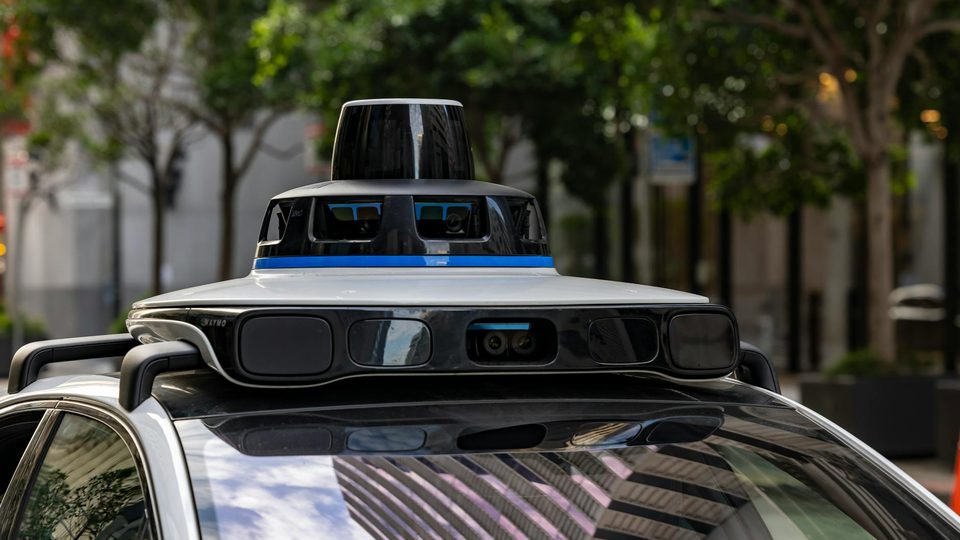
Much of the excitement around LiDAR focuses on one number: resolution. The more important question is usually where the system spends its resolution budget. That is what makes recent work on gaze-enabled or bionic FMCW LiDAR interesting. Instead of scanning every direction with the same density, the sensor reallocates attention, preserving broad awareness while concentrating higher-detail sensing where the scene matters most.
That is not only a photonics story. It is a systems story about how future perception stacks may stop treating every pixel, angle, and target region as equally valuable.
What “Bionic” Means in This Context
The term “bionic” is not about imitation for its own sake. It refers to a retina-like sensing strategy. Human vision does not process the full scene at one uniform resolution. It combines broad contextual awareness with a smaller region of concentrated attention. A bionic LiDAR concept applies a similar logic to machine sensing.
In practical terms, that means:
- maintain enough broad coverage to preserve context,
- identify regions of interest,
- and then spend higher sensing density where more detail is operationally valuable.
This matters because perception systems almost always face the same trade-off: they want more coverage, more detail, lower power, lower cost, and lower complexity at the same time. Uniform scanning does not solve that trade-off efficiently.
Why FMCW LiDAR Is Different
FMCW LiDAR is attractive because it is not only a ranging technology. Like FMCW radar, it uses a frequency-modulated continuous waveform and can support distance estimation together with motion-related information through coherent detection. That is why FMCW LiDAR is often described as a “4D” sensing candidate: it can provide depth and reflectivity-like scene structure while also supporting velocity-aware perception.
That does not make every FMCW LiDAR system operationally mature. It does explain why researchers see it as a richer sensing architecture than conventional time-of-flight approaches in some use cases.
Why Adaptive Allocation Matters More Than a Bigger Spec Sheet
The key idea in adaptive or bionic LiDAR is not “scan more.” It is “scan intelligently.” A perception system usually does not need maximum density everywhere. It needs enough density in the right place at the right time.
This is important because adaptive allocation can improve:
- local detail where a decision is about to be made,
- compute efficiency by avoiding unnecessary full-scene density,
- and total system usefulness without scaling hardware cost linearly with scene size.
In other words, adaptive perception is a resource-allocation strategy, not just a sensor feature.
Why This Is Called 4D Machine Vision
The “4D” label is often used loosely, so it helps to be precise. In this context it usually means that the system is trying to sense three-dimensional position together with motion or temporal behavior in a way that supports scene understanding over time.
That matters because future machine-vision systems are not judged only by whether they can see a scene. They are judged by whether they can:
- identify the region that matters,
- preserve timing relevance,
- and measure how the scene is changing.
This is one reason coherent FMCW LiDAR research draws attention. It supports the idea that perception should be dynamic and selective rather than uniformly exhaustive.
What It Could Mean for Real Systems
Near-term deployments are unlikely to replace every existing perception stack with adaptive FMCW LiDAR. The more realistic lesson is architectural. Future systems may increasingly combine:
- wide-field context sensing,
- high-detail local interrogation,
- and software that changes sensor behavior dynamically.
That logic already appears in many surveillance and autonomy stacks. Broad-area watch and high-detail confirmation are usually not handled by the same layer in the same way.
Why This Matters for Security and Surveillance
Security platforms are moving toward the same idea even when they do not use LiDAR:
- radar provides persistent watch,
- optics provide high-detail confirmation,
- and command software decides where attention should go next.
That is why adaptive LiDAR research is useful even for readers who are not buying a LiDAR system today. It reinforces an existing operational truth: the strongest architecture is often the one that knows where to spend attention.
This topic therefore connects naturally to Radar, LiDAR, Ultrasonic, and OTH Radar: Which Sensing Layer Solves Which Problem?, Frontier Radar Technologies: What Is Real, What Is Emerging, and What to Watch, and the Cyrentis CR Series radar products. The lesson is less about one sensor family winning and more about selective perception becoming a design principle.
What Still Limits Deployment
Adaptive FMCW LiDAR remains an emerging category, so the engineering questions are still significant:
- system size and packaging,
- power efficiency,
- scene robustness,
- compute burden,
- calibration stability,
- and whether the adaptive behavior creates measurable end-user value.
These questions matter because many sensing concepts look compelling in research while remaining difficult to deploy at scale. The transition from paper to product still depends on cost, reliability, and integration discipline.
What to Watch Next
For practical teams, the most useful signals are not marketing demos. Watch for:
- whether adaptive resolution control works reliably in dynamic scenes,
- whether motion-aware FMCW data improves real decision quality,
- whether the system can fuse cleanly with cameras or radar,
- and whether the hardware burden is justified by the operational gain.
Those are the tests that separate a compelling research direction from a deployable sensing class.
Conclusion
Bionic FMCW LiDAR matters because it points toward a broader shift in machine perception: future systems will not simply collect more data, they will try to collect the right data in the right place at the right time. The real lesson is therefore architectural. Adaptive, attention-aware sensing may become more important than uniform full-scene density as machine vision systems mature.
Official Reading
- Nature Communications: Integrated Bionic LiDAR for Adaptive 4D Machine Vision - Primary research paper behind the recent bionic FMCW LiDAR discussion.
- NASA: Improving Lidars for Exploration and Science - Useful official context on why advanced lidar architectures matter for sensing performance and deployment.
- NASA NTRS: An Overview of NASA Lidar Technologies - Useful official overview of lidar technology directions, including coherent and navigation-relevant architectures.