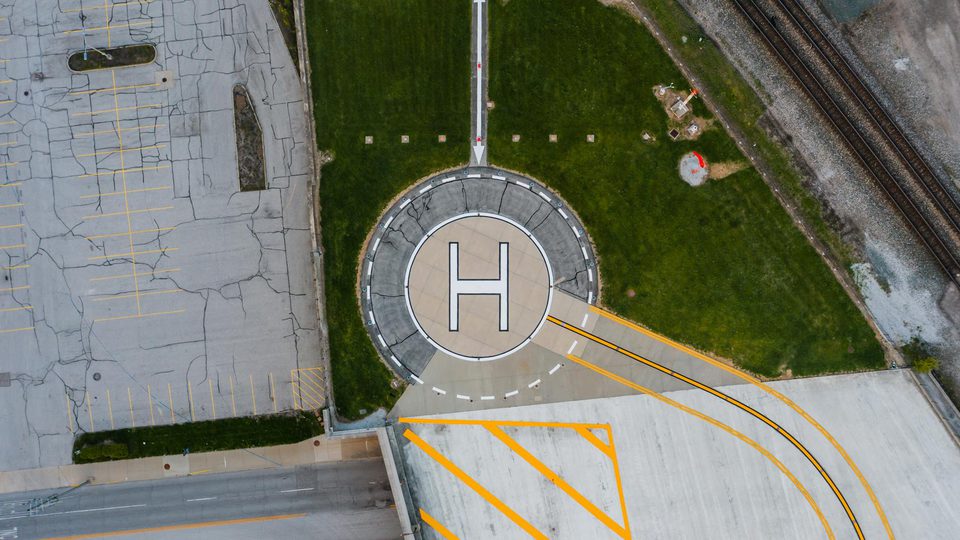
Urban air mobility safety is often associated with aircraft certification, propulsion, and autonomy, but operational safety in cities depends just as much on what happens around the vehicle. Vertiports, route corridors, emergency procedures, nearby drone activity, and local airspace awareness all contribute to whether urban operations remain predictable and scalable.
That is why UAM safety should be treated as a system problem. Aircraft, infrastructure, procedures, and monitoring all have to fit together in the same low-altitude operating picture.
Why UAM Needs Local Awareness
Urban air mobility will depend on cooperative services and structured procedures, but those alone do not explain every possible safety issue. Vertiport operations, nearby construction, municipal restrictions, emergency scenes, and unexpected low-altitude traffic can all affect the local environment around an operation.
So a useful safety architecture needs to answer:
- what cooperative flights are expected,
- what local activity may create conflict,
- what the relevant airspace restrictions or temporary conditions are,
- and how anomalies are escalated.
A Practical UAM Safety Stack
The table below is a synthesized planning aid.
| Layer | Main role for UAM safety | Common mistake |
|---|---|---|
| Cooperative traffic services | Provides route, scheduling, and operator context | Assuming planned data removes the need for local awareness |
| Vertiport-area monitoring | Watches the immediate operational environment around pads and approaches | Looking only at the aircraft and not the operating zone |
| Local conflict detection | Highlights unexpected or non-cooperative activity nearby | Treating anomaly detection as a later-phase problem |
| Safety workflow | Connects alerts, procedures, and operator action | Leaving vertiport teams without a shared operational display |
The FAA’s Advanced Air Mobility implementation plan and NASA’s Advanced Air Mobility program both reinforce the idea that scalable operations require infrastructure, procedures, and information-sharing, not just aircraft capability.
Vertiports Are Operational Nodes, Not Just Landing Pads
A vertiport is a coordination point where passenger handling, ground safety, airspace procedures, and local sensing may intersect. Treating it as a simple landing surface underestimates the operational complexity. Monitoring around vertiports should therefore be designed for continuity and anomaly handling, not just for perimeter observation.
Safety Monitoring Should Stay Practical
UAM projects can easily drift into abstract future architectures. The more practical approach is to ask what an operator or supervisor must know in real time: Is the local airspace behaving as expected? Is there an unexpected low-altitude object? Does the route or pad environment require a procedural change? That is the level where monitoring becomes operationally valuable.
Vertiport Operating States Need Different Safety Logic
Urban air mobility safety is often described as if one consistent rule set will cover all phases of operation. In reality, risk changes across pad turnaround, embarkation, final approach, departure, and contingency handling. The questions that matter during scheduled passenger loading are not identical to the questions that matter when weather shifts, a route change is issued, or the pad needs to be held because of unexpected nearby traffic.
That means the monitoring layer should not treat the vertiport as a static object. It should reflect the operating state of the site. A system that understands whether a pad is inactive, preparing for arrival, actively turning an aircraft, or in a degraded or emergency state gives operators a more realistic basis for judging what nearby activity matters and what response path should follow.
UAM Safety Depends on Surrounding Ground Activity Too
The aircraft and route corridor are only part of the safety envelope. Ground support vehicles, nearby construction equipment, cranes, rooftop access, emergency services, and public congregation points can all change the operational picture around a vertiport. In dense urban areas, local conditions evolve quickly and may not be captured well by a purely cooperative airspace service.
This is one reason local awareness still matters even in a highly managed future AAM environment. Operators need enough visibility into the immediate environment to know whether the route and pad remain suitable for the next movement. That may involve temporary hazards, non-cooperative drone activity, changing municipal conditions, or a need to temporarily narrow the accepted operating envelope.
Contingency Procedures Should Drive Monitoring Design
One of the strongest tests of a UAM safety architecture is not routine operation but abnormal operation. What happens if an arrival has to hold unexpectedly, a pad closes, a non-cooperative object appears near the route, or communications degrade between local teams and the broader traffic service? If monitoring is built only for nominal conditions, it will struggle precisely when safety margins matter most.
A more resilient approach designs the local safety picture around contingency use cases from the start. Supervisors should be able to see what airspace or pad conditions changed, which operations are affected, and what procedural options remain available. Good monitoring shortens the gap between recognizing an anomaly and choosing a safe operational response.
Phased Rollout Is a Safety Tool, Not a Compromise
Because urban air mobility is emerging, many organizations will begin with limited routes, small numbers of pads, and tightly managed operating windows. That should not be viewed as a weakness. A phased rollout is one of the best ways to learn what information operators truly need and where the local monitoring picture is thin.
Early deployments can reveal how much local variability exists around a vertiport, how cooperative and non-cooperative traffic interact, and which alerts are useful versus distracting. Those lessons make later scaling safer. In that sense, operational discipline and information design are as important to UAM safety as the underlying sensors.
Conclusion
Urban air mobility safety is an operational integration problem as much as an aircraft problem. The most useful monitoring architecture keeps route context, vertiport state, local anomalies, and contingency procedures in one practical picture. As cities and operators begin to scale low-altitude transport, the systems that perform best will be the ones that help teams adapt safely to changing local conditions rather than simply display idealized route plans.