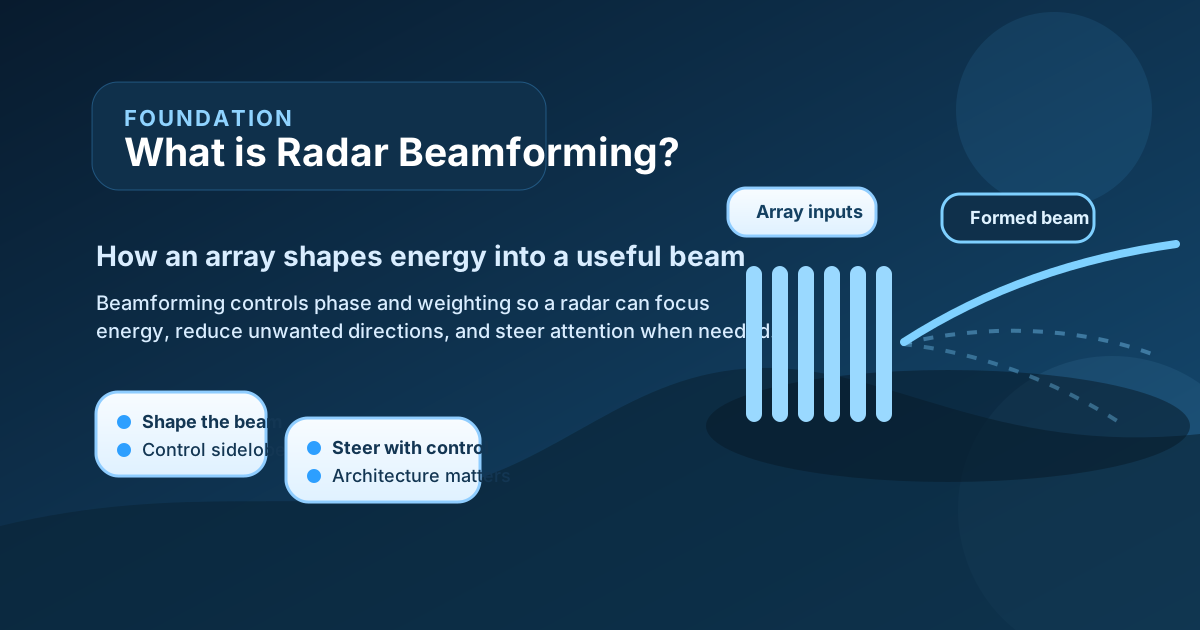
What is radar beamforming? In simple terms, beamforming is the process of combining signals across an antenna array so the radar beam becomes stronger in selected directions and weaker in others. Instead of treating all array elements as isolated parts, the radar controls how those elements work together. That control shapes the main beam, influences sidelobes, and can also allow the beam to scan toward different angles.
Beginners often first meet this idea through phased-array radar. That is reasonable, because phased arrays are where beamforming becomes most visible. But the beginner should not reduce the topic to “beamforming means the beam moves.” Beam steering is one important use of beamforming, but it is not the whole idea. Beamforming is really about how the array’s signals are weighted, timed, or phase-shifted so the radiation pattern does what the system needs.
MathWorks summarizes this neatly in its beamforming overview by describing beamforming as the process of generating a directional beam from an antenna array. The same page explains that the array can be weighted to control sidelobes or scanned by changing progressive phase difference across the elements. NOAA and NSSL make the operational side clear from the radar perspective: phased-array radar can steer the beam electronically while the antenna remains stationary, and different beamforming architectures involve different cost and flexibility trade-offs. Put together, these sources point to the same beginner lesson. Beamforming is not just a buzzword around phased arrays. It is the control logic that tells the array how to radiate and listen.
So the short answer is this: radar beamforming is how an antenna array is made to act like a focused directional sensor instead of just a collection of elements. The practical question is how much control the radar has over that focus and what that control costs.
What Beamforming Actually Means
Start with the array itself.
An antenna array contains many radiating elements. If those elements are excited in the same way, the array will still radiate, but not with the same level of control that a radar often needs. Beamforming changes that by assigning weights, phase relationships, delays, or other control patterns across the array.
MathWorks describes two major beginner-friendly beamforming ideas:
side lobe control, where amplitude weighting changes how much energy appears in unwanted directions,- and
beam scanning, where progressive phase change steers the beam toward a chosen angle.
That is useful because it shows beamforming has at least two jobs. One job is shaping where the beam is strongest. Another job is reducing energy where the beam should not be strong. In real radar work, both matter. A narrow main beam is valuable, but if unwanted sidelobes remain too high, the radar can still receive or transmit significant energy in directions that complicate interpretation.
This is why beamforming is not just about aiming. It is about pattern control.
If the beginner wants a plain-language analogy, think of the array as a group of people pushing a large object. If they all push with exactly the same timing and strength, the object moves one way. If some push a little earlier, later, stronger, or weaker, the result changes. Beamforming is the radar’s way of telling the array how to “push” the electromagnetic wavefront so the final beam has the shape and direction the mission needs.
How Radar Beamforming Works
The underlying physics can become mathematically heavy, but the operational idea is manageable.
Each antenna element contributes part of the transmitted or received field. When the array combines those contributions coherently, some directions reinforce strongly while others do not. By controlling the relative phase or timing across the array, the radar can shift the direction of strongest reinforcement. By controlling amplitude weighting, it can influence sidelobe behavior and beam shape.
MathWorks explains this directly in its documentation: beam scanning is achieved by controlling the progressive phase difference between array elements, while sidelobe control is achieved through amplitude taper or weighting. These are excellent beginner entry points because they show that beamforming is not one magic setting. It is a family of array-control choices.
In radar use, this can happen on transmit, on receive, or on both. Some systems combine electromagnetic signals earlier in the chain. Others digitize more channels and combine them later in digital processing. That architectural difference matters because it affects how much flexibility the radar has once the hardware is built.
NOAA’s MPAR program material is especially useful here. It contrasts analog sub-array beamforming and all-digital beamforming. In the analog approach, signals from multiple elements are combined before the digital stage in a more constrained way. In an all-digital approach, each radiating element has its own receiver and ADC, and the digital signals are then combined to form the radar beam. NOAA explains that the all-digital architecture offers maximum flexibility, allowing on-the-fly reconfiguration of the number and shape of radar beams.
That is a major beginner takeaway. Beamforming is not only a theory topic. The system architecture determines how much beamforming freedom the radar really has.

Figure: Synthesized explainer showing how an array combines weighted element outputs into a stronger main beam while reducing energy in less useful directions.
Beamforming vs Beam Steering
This distinction matters because the terms are often blended together.
Beam steering means changing where the beam points. Beamforming is the broader control process that creates the beam pattern in the first place and can also steer it. So beam steering is one use of beamforming, not a full definition of beamforming.
That is why a beginner can get confused when reading phased-array material. Many pages emphasize electronic steering because it is easy to visualize and operationally important. NSSL, for example, explains that phased-array radar can steer the beam electronically left-to-right and up-and-down while the antenna remains stationary. That is correct, but it does not mean beamforming is only about steering.
Beamforming also affects:
- beamwidth,
- sidelobe levels,
- gain in the desired direction,
- interference behavior,
- and sometimes the number of beams or receive channels the radar can support.
So if someone asks what radar beamforming is, the safest beginner answer is: it is the way an array is controlled to shape and direct the beam. Steering is only one part of that story.
Why Beamforming Matters in Radar
Beamforming matters because radar performance depends heavily on how well energy is concentrated and interpreted.
If the radar can put more useful energy into the desired direction and reduce response from unwanted directions, it usually gains operational advantages. Those may include:
- better directional focus,
- more efficient scanning,
- lower confusion from unwanted directions,
- improved update behavior in electronically scanned systems,
- and stronger flexibility in how the radar assigns attention.
This is one reason phased-array radar is so closely linked with beamforming. The array becomes more than a fixed aperture. It becomes a configurable sensing surface.
NOAA’s phased-array work shows the operational value clearly. The Advanced Technology Demonstrator page explains that the phased array can steer electronically while the antenna remains stationary and that the faster updates are part of the benefit. The MPAR congressional report then extends the idea by showing that digital beamforming architecture can allow on-the-fly reconfiguration of beam number and shape depending on operational conditions. For a beginner, that means beamforming is part of how the radar turns hardware into mission behavior.
In simpler terms, beamforming matters because it tells the radar where to look, how sharply to look, and how much unwanted energy to tolerate while doing it.
Analog, Sub-Array, and Digital Beamforming
Not all beamforming architectures offer the same flexibility.
Analog Beamforming
In a more analog approach, many element signals are combined earlier in the chain. This can reduce complexity, but it also limits how much individual element control is retained later.
Sub-Array Beamforming
NOAA’s MPAR material discusses sub-array beamforming as a design trade-off. Signals may be combined from several elements or one panel before later digital processing. This can reduce channel count and cost, but it also reduces some of the flexibility that a more fully digital architecture could provide.
Digital Beamforming
In all-digital beamforming, NOAA explains that each element has its own receiver and ADC, and digital signals are combined afterward to form the beam. This gives much more freedom to change beam shape, beam number, or operational mode. The price is more hardware complexity, processing demand, and cost.
This is one of the most important beginner lessons in the topic. Beamforming is not simply a yes-or-no capability. The question is what kind of beamforming the radar has and how much control it preserves.
What Changes Beamforming Quality
Several practical factors affect how useful beamforming becomes.
Element Count and Array Geometry
A larger or more capable array can support more refined beam control, but geometry matters too. The layout of the array shapes what kinds of beams are practical and how well they can be steered.
Weighting Strategy
MathWorks notes that amplitude tapering can reduce sidelobes but also changes half-power beamwidth. That is a classic trade-off. Better sidelobe suppression may come at the cost of a wider main beam.
Steering Angle
Beam performance is not always identical at every steering angle. NOAA’s MPAR report notes that beam characteristics of an electronically steered phased array change depending on beam position and the performance of distributed transmit/receive elements. This is why calibration by beam position matters.
Calibration
NOAA emphasizes that phased-array calibration must be considered and routinely monitored because beam characteristics vary with steering and with the performance of distributed elements. A theoretically strong beamforming design can still underperform if calibration control is weak.
Processing and Cost
More flexible beamforming often means more receivers, more digitization, and more processing burden. That can improve performance, but it also raises complexity and cost.

Figure: Synthesized factor map showing why beamforming quality depends on array geometry, weighting strategy, steering angle, calibration, and digital architecture choices.
For beginners, this means beamforming should be treated as a trade-off space, not a free improvement.
Common Mistakes
Several misunderstandings appear again and again.
“Beamforming just means electronic steering”
No. Steering is one use of beamforming. Beamforming also shapes sidelobes, beamwidth, and pattern behavior.
“All phased arrays have the same beamforming flexibility”
No. Analog, sub-array, and digital beamforming architectures preserve different levels of control.
“Digital beamforming is automatically the best answer”
Not always. It can offer maximum flexibility, but it also brings higher cost, greater processing burden, and more demanding implementation.
“A steered beam behaves the same at every angle”
No. Beam characteristics can change with steering angle and system calibration.
“Beamforming solves every radar problem”
No. It improves how the array uses its energy, but radar performance still depends on waveform choice, signal processing, clutter, range, and mission design.
What This Means in Practice
For a beginner, the best mental model is this: beamforming is how a radar array turns many small antenna elements into one purposeful beam.
If you are evaluating a radar design, useful questions include:
- whether beamforming is analog, sub-array, or digital,
- whether the main need is steering, sidelobe control, or both,
- how beam performance changes across steering angles,
- how calibration is maintained,
- and what level of flexibility the mission actually needs.
These questions are better than simply asking whether the radar is “phased array.” A phased-array label does not by itself tell you how much beam control the system really has.
This also explains why beamforming is such a central concept in modern radar architecture. It connects antenna physics, scan strategy, and system cost. It is not only about making the beam move faster. It is about shaping how the radar pays attention.
Conclusion
Radar beamforming is the process of combining and weighting array elements so the radar beam is focused where it should be strongest and weaker where it should not. It can support beam steering, sidelobe control, beam shaping, and in more advanced architectures even flexible reconfiguration of multiple beams.
The key takeaway is that beamforming is broader than steering. It is the control method that determines how an array behaves as a sensing system. The right beamforming architecture depends on mission needs, cost limits, calibration demands, and how much flexibility the radar must preserve in operation.