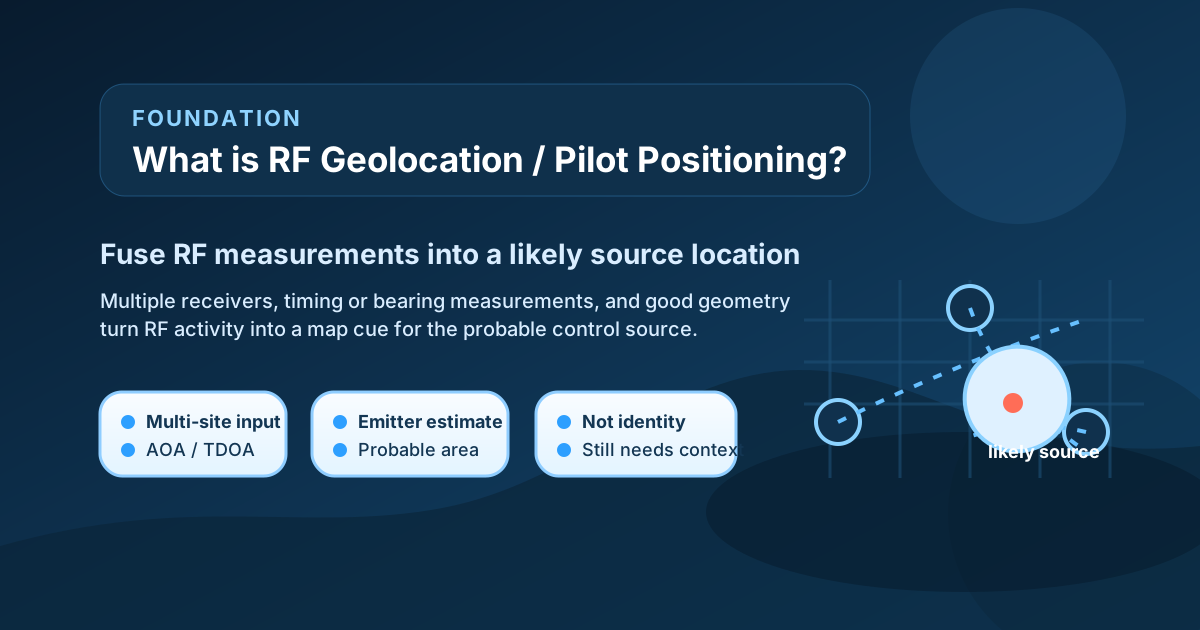
What is RF geolocation, and what does pilot positioning mean? In simple terms, RF geolocation is the process of estimating where a radio transmitter is by measuring its signal. In counter-UAS or security workflows, pilot positioning usually means trying to estimate where the drone operator, remote controller, or related RF emitter is located on the ground.
That makes the topic different from simple drone detection. Detection asks whether something is transmitting. Geolocation asks where the transmitter is. In many security situations that difference matters a lot. If the problem is only “there is a drone somewhere nearby,” that may be enough for alerting. But if the operator needs to understand where the controller is, where the source of the link is, or where to focus response activity, then RF geolocation becomes much more important.
This is also where beginners can get confused. Some people assume that if a system detects a drone control signal, it automatically knows the exact pilot position. Usually it does not. Geolocation is a harder step than detection. The system may need multiple receivers, multiple measurements, more time, or a hybrid locating method. Even then, the result may be a probable area, a confidence region, or a best estimate rather than a perfect point.
Rohde & Schwarz describes hybrid geolocation as combining angle-based and time-based locating methods because each has different strengths. The FAA’s Remote ID material provides another useful distinction: a cooperative drone may broadcast control-station or takeoff-point information, but that is different from independently estimating emitter location from RF measurements. So the beginner takeaway is this: pilot positioning is an RF locating problem, not just a signal-presence problem.
What RF Geolocation Actually Means
RF geolocation is the broader technical task of estimating where a transmitter is in physical space. The transmitter might be:
- a handheld controller,
- a telemetry radio,
- a video downlink,
- a Remote ID source,
- or some other RF-emitting device of interest.
In a drone-security context, people often say pilot positioning because the operational goal is not just to find any emitter. The goal is to find the likely location of the person or device controlling the aircraft. But those two phrases are not perfectly identical. A system may geolocate an RF source that is related to the operation without proving that it is the pilot’s exact body position. It may be the controller, a takeoff location, a relay point, or another relevant transmitting element.
That distinction matters because words like pilot location can sound more certain than the data really is. In some cases the best the system can say is:
- this is the likely origin sector,
- this is the most likely emitter area,
- or this is the estimated location of the transmitting source associated with the drone link.
For beginners, that is the safer mental model. RF geolocation is about estimating emitter location from measurements. The workflow may support pilot response, but the measurement itself is still an RF estimate, not an automatic legal identity statement.
How Pilot Positioning Usually Works
In a practical system, pilot positioning often unfolds as a sequence rather than as one magical calculation.
First, the system must detect and classify a relevant signal. That might be a control link, telemetry signal, video link, or Remote ID transmission. Detection alone is not enough, but without a usable signal there is nothing to geolocate.
Second, one or more sensors measure the signal in a way that is useful for location estimation. Depending on the system, that may involve:
- angle of arrival, or AOA,
- time difference of arrival, or TDOA,
- a hybrid combination,
- or another supporting measure such as frequency, timing, or signal fingerprint context.
Third, the measurements are fused into a location estimate. One sensor may give only a direction or sector. Multiple sensors can narrow the solution. A hybrid engine may fuse different measurement types to improve the result in a more difficult environment.
Fourth, the result is displayed as something operationally useful: a bearing line, an estimated point, a confidence ellipse, a probable search area, or a map cue for another team or sensor.

Figure: Synthesized explainer showing the common workflow from RF signal capture to fused location estimate and operator map output.
This is why RF geolocation is usually a systems function rather than a single-box function. It depends on sensor placement, receiver performance, timing, measurement quality, data fusion, and workflow display. A strong product or system is not only one with an impressive locating algorithm. It is one where the measurements can be collected, fused, and acted on quickly enough to matter.
AOA, TDOA, and Hybrid Methods
To understand pilot positioning, it helps to keep the locating methods separate.
AOA estimates where the signal is coming from as a direction. A direction finder gives a bearing from the sensor site. One bearing is useful, but usually not a full location by itself.
TDOA estimates location from arrival-time differences measured across multiple receivers. In simple terms, the system compares when the same signal reaches different sites. The differences constrain where the emitter could be.
Hybrid geolocation combines both. Rohde & Schwarz explains that hybrid geolocation fuses the capabilities of AOA and TDOA because the two methods have different strengths and weaknesses. The same source also notes that TDOA tends to locate best when receivers surround the emitter, while direction finders can still help determine locations of outlying emitters more flexibly.
For beginners, the practical lesson is not to memorize every mathematical detail. The practical lesson is that pilot positioning is often a geometry problem. The quality of the answer depends on where the receivers are, how strong and clean the signal is, and which locating method best matches that environment.
Why Pilot Positioning Matters in Security Workflows
This topic matters because in many real incidents, the drone in the sky is only half the operational problem.
Security teams may also need to know:
- where the controller is,
- whether the control source is moving,
- whether the source is inside or outside the protected area,
- and how to direct response or additional sensing.
That is why pilot positioning can change the value of RF sensing. If the system only says “RF activity exists,” the next step may still be broad and uncertain. If the system can say “the likely source is in this sector” or “the probable controller location is near this point,” the workflow becomes much more actionable.
This does not mean RF geolocation solves everything. It means it changes the quality of the response picture. A radar may tell the operator where the aircraft is moving. An optical system may verify what the aircraft appears to be. RF geolocation helps answer where the associated transmitting source is likely located. Those are different questions, and together they create a more complete situation picture.
What Changes Geolocation Quality
Beginners often look for one accuracy number, but geolocation quality depends on several conditions.
Number and Placement of Sensors
One of the most important variables is geometry. Multiple sites usually produce stronger location results than one site because they reduce ambiguity. The hybrid geolocation white paper also makes clear that geometry shapes which method performs best and where the strongest results can be expected.
Signal Quality
Weak signals, noisy environments, interference, and intermittent transmissions all reduce measurement quality. The cleaner and stronger the signal relative to the noise floor, the more stable the location estimate can become.
Multipath and Urban Reflections
Cities and industrial sites are difficult RF environments. Reflections from buildings, metal surfaces, and vehicles can distort direction or timing estimates. This is one reason field results may differ greatly from controlled test examples.
Emitter Behavior
A continuously transmitting signal is often easier to work with than a short burst or irregular transmission. Frequency hopping, low duty cycle behavior, and highly dynamic links can all make geolocation more difficult.
Method Choice
AOA, TDOA, and hybrid approaches do not fail in the same way. AOA may remain valuable for directional cueing where receiver geometry is less ideal for TDOA. TDOA can be very powerful when the receiver network surrounds the area of interest. Hybrid approaches try to take advantage of both.
Workflow Latency
A location estimate is more valuable if it arrives while the event is still actionable. In operational terms, confidence is not only about map precision. It is also about whether the output arrives quickly enough to support a decision.

Figure: Synthesized factor map showing why pilot-position estimates depend on receiver geometry, signal quality, method choice, and operational latency.
RF Geolocation Is Not the Same as Remote ID
This is an important beginner distinction.
Remote ID is a cooperative broadcast identification layer. RF geolocation is an independent measurement process that estimates emitter location from sensed RF data. A system may use both, but they are not the same thing.
FAA materials explain that a Standard Remote ID drone broadcasts drone and control-station information, while a broadcast module path reports the drone location and takeoff location. That information can be extremely useful when present and compliant. But RF geolocation serves a different role. It does not rely on the emitter volunteering a friendly self-report in the same way. It uses measurements from the sensing network.
This difference matters because:
- not every aircraft will be cooperative,
- not every signal of interest is a Remote ID broadcast,
- and not every usable RF location result tells you legal identity or authorization status.
So a cooperative ID layer and an independent RF locating layer should be understood as different but potentially complementary tools.
Limits and Common Misunderstandings
Several misconceptions appear again and again.
“If the drone is detected, the pilot location is guaranteed”
No. The system still needs a usable RF emitter and enough measurement quality to estimate a source location.
“Pilot positioning always means exact human position”
No. Often the system estimates the location of the relevant transmitter or control source. That may be close to the operator, but the measurement is still about RF origin.
“RF geolocation replaces all other sensors”
No. It answers an RF-origin question. It does not replace radar, optical verification, or broader situational context.
“Remote ID makes RF geolocation unnecessary”
No. Remote ID is cooperative broadcast information. RF geolocation is an independent measurement layer. They solve related but different problems.
“One method works best everywhere”
No. Receiver geometry, environment, and signal behavior determine whether AOA, TDOA, or hybrid logic is the better fit.
What This Means in Practice
For a beginner, the best mental model is this: RF geolocation tries to turn RF activity into a usable location estimate.
In counter-UAS workflows, that often means helping the operator answer a ground-side question: where is the control source likely located? Sometimes the answer is a bearing. Sometimes it is a probable point. Sometimes it is only a search area. The quality of that answer depends on method, geometry, and environment.
This is also why pilot positioning should be treated carefully in planning and procurement. Good questions include:
- what signals are actually geolocatable,
- how many sensors are required,
- what geometry the site allows,
- how the system expresses confidence,
- and how the result is fused with radar, EO/IR, or command software.
Those questions reflect real deployment value far better than assuming every detected drone automatically yields a clean pilot map point.
Conclusion
RF geolocation is the process of estimating where a transmitter is by measuring its signal. In drone-security workflows, pilot positioning usually means applying that logic to the controller or related RF source associated with the aircraft. That makes it much more actionable than simple detection, but also more demanding.
The key takeaway is that pilot positioning is a measurement and fusion problem, not a magic certainty problem. It can be very useful when receiver geometry, signal quality, and method choice are strong. But it should still be understood as an estimate of RF origin, not a guaranteed identity or a universal answer for every drone scenario.