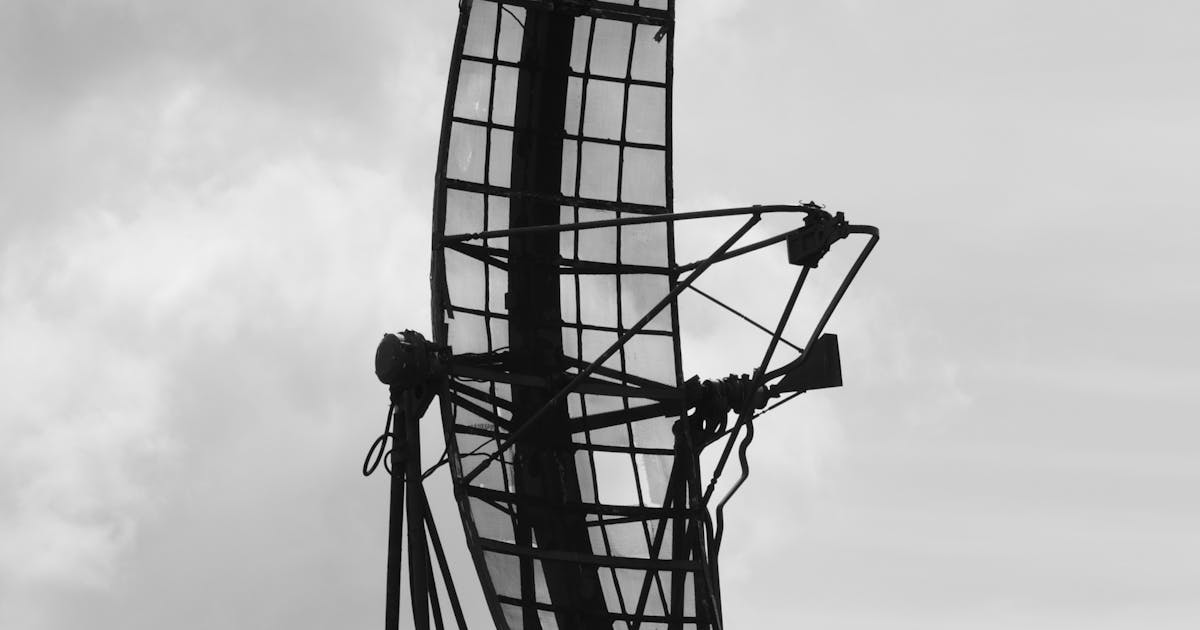
Single-face radar and rotating radar are two common ways to scan low-altitude airspace. Both can be useful for drone detection, but they create different trade-offs in coverage, update rate, mechanical complexity, installation, and cost.
The simple distinction is this: a single-face radar looks into a fixed sector, while a rotating radar turns a sensor or antenna to scan around a wider area. A rotating system may cover 360 degrees with one rotating assembly. A single-face system may need multiple fixed faces to cover all directions, but each face can watch its assigned sector continuously.
What Single-Face Radar Means
A single-face radar uses one fixed antenna face or array. It is aimed toward a defined sector such as a perimeter line, runway approach, rooftop direction, valley, coastline, or critical asset. It does not mechanically spin to see every direction.
Because it keeps looking at the same sector, it can update targets in that sector frequently. This can help with small drones, slow targets, hovering targets, or targets that require stable camera cueing. If the protected direction is known, a fixed face can be an efficient choice.
The limitation is coverage angle. One face cannot see everything around the site unless its field of view is very wide, and wider fields can create trade-offs in gain, resolution, or processing. To build full 360-degree coverage, a system may need two, three, four, or more fixed faces, depending on the radar design.
What Rotating Radar Means
A rotating radar uses mechanical rotation to scan a wider area. Traditional surveillance radars often rotate continuously, sweeping the antenna through 360 degrees. This architecture is familiar in maritime, airport, and general surveillance applications.
The advantage is broad coverage from one rotating sensor. For sites that need a general picture around a central point, rotating radar can be attractive. It can also reduce the number of fixed faces required for wide-area awareness.
The trade-off is revisit time. A target is updated when the radar beam returns to that direction. If the radar rotates slowly, a small drone may move or change behavior between updates. If it rotates faster, mechanical and signal-processing design become more demanding.
Coverage vs Update Rate
Coverage angle and update rate are often in tension. Rotating radar can provide wide coverage, but the radar is not looking at every direction all the time. Single-face radar can stare at a sector, but may not cover other directions.
For drone detection, update rate matters because small drones can be weak, low, slow, or irregular. A fast update helps maintain tracks, cue cameras, and reduce uncertainty. Revisit time is especially important near protected zones where operators need timely alerts.
This does not mean rotating radar is bad. A well-designed rotating radar can be effective, especially for broad surveillance. It means buyers should ask how often each sector is revisited and whether that update rate supports the target set and response workflow.
Mechanical Complexity and Maintenance
Single-face radars often have fewer moving parts, especially when built with electronically scanned arrays. Fewer moving parts can simplify maintenance and improve uptime in harsh environments, although the electronics and thermal design still matter.
Rotating radars include mechanical motion. Bearings, motors, slip rings, seals, drive systems, and rotation control may require maintenance. Good industrial design can make rotating systems reliable, but mechanical wear should be considered in long-term operations.
For remote sites, rooftop installations, coastal environments, sand, ice, or high-wind areas, maintenance access and environmental protection may influence the architecture choice.
Track Continuity and Camera Cueing
Counter-UAS operations often require more than seeing a target once. The system must maintain a track, decide whether it matters, and cue EO/IR cameras. Track continuity is therefore a practical metric.
A single-face radar may update a target more frequently inside its sector, which can help with smooth tracks and camera cueing. A rotating radar may provide wider awareness, but the track may update only once per scan in a given direction.
If a site has multiple EO/IR cameras and fast response requirements, track update rate becomes important. A delayed or intermittent track can make the camera search area larger and reduce confirmation speed.
When Single-Face Radar Fits
Single-face radar can be a good fit when:
- the main threat directions are known;
- the site needs strong coverage of a specific sector;
- fast update rate and track stability are priorities;
- multiple fixed faces can be installed for wider coverage;
- maintenance access for moving parts is limited;
- the radar must be integrated into walls, rooftops, masts, or fixed perimeters.
Examples include perimeter protection, runway approaches, industrial facilities, data centers, border corridors, and directional coverage around terrain or infrastructure.
When Rotating Radar Fits
Rotating radar can be a good fit when:
- a single sensor must provide broad 360-degree awareness;
- the site is relatively open;
- revisit time is sufficient for the target and response requirement;
- mechanical maintenance is acceptable;
- the project favors one central surveillance point;
- the radar is part of a broader sensor network that can compensate for update limitations.
Examples include open-area surveillance, maritime-style monitoring, temporary central deployments, and sites where broad awareness is more important than continuous stare into one sector.
The Multi-Face Alternative
Many modern low-altitude systems use multiple fixed faces to achieve 360-degree coverage without mechanical rotation. This can combine continuous sector coverage with full-area awareness. The trade-offs are cost, power, installation complexity, calibration, and data fusion.
Multi-face architecture can be attractive for high-security sites that need fast updates in all directions. It is not automatically better for every project, but it is important to include in the comparison.
What Buyers Should Ask
When comparing single-face and rotating radar, ask:
- What field of view does each face cover?
- What is the update rate or revisit time by sector?
- Can the system maintain stable tracks for small, slow, or hovering drones?
- How does the radar cue EO/IR cameras?
- What moving parts require maintenance?
- What happens if one face or rotation mechanism fails?
- How does the design handle wind, rain, dust, salt, ice, or vibration?
- Is 360-degree coverage truly required, or are some sectors more important?
- Would multiple fixed faces, one rotating radar, or a hybrid layout best match the site?
These questions are more useful than choosing an architecture by name.
Conclusion
Single-face radar and rotating radar are both valid architectures. A single-face radar offers continuous attention to a fixed sector and can support fast updates. A rotating radar offers broad coverage with one rotating assembly but introduces revisit-time and mechanical considerations.
The best choice depends on the site. For counter-UAS projects, compare architectures against real protected sectors, target behavior, update requirements, camera cueing, maintenance, and system integration. The right radar is the one that supports the operational workflow, not simply the one with the widest theoretical coverage.