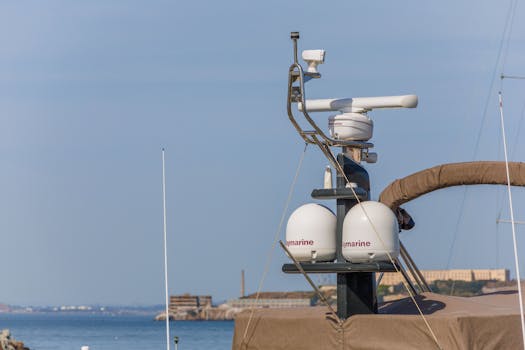
As cooled MWIR and multispectral EO payloads become more affordable, many integrators wonder if radar is still required. In practice, radar remains the only sensor that ensures true all-weather, all-time situational awareness. Radar and EO are not competitors — they are complementary technologies built on different physical principles.
1. Coverage vs. Clarity
| Attribute | Radar | Electro-Optical |
|---|---|---|
| Detection Principle | Active (microwave emission) | Passive (light/thermal) |
| Field of View | 360° wide-area | Narrow (2–20° typical) |
| All-Weather Operation | Works through rain, fog, dust, night | Affected by light, fog, glare |
| Response Logic | Instant pre-warning | Visual confirmation |
| Target Type | Drones, vehicles, vessels, humans | Visible or heat-emitting objects |
| Role in System | Detection & cueing | Identification & verification |
EO shows what’s happening — radar tells where it’s happening. EO lets you see. Radar lets you find.
2. Radar as the First Layer of Awareness
In an integrated surveillance chain:
Detect (Radar) → Locate → Cue (EO) → Identify → Decide → Act
Without radar, EO sensors are blind scanners. With radar, EO units become intelligent, automatically pointing to detected targets. That’s why every modern C4ISR system starts with radar.
3. The True Cost Equation
While EO systems look cheaper per unit, they cover only a small area. To match one radar’s coverage radius (3–8 km), you might need dozens of EO turrets — each requiring power, network, towers, and maintenance.
Radar therefore reduces total ownership cost (TCO) while ensuring 24/7 protection.
“If you only deploy EO, you are monitoring. If you deploy radar, you are defending.”
4. Reliability in Harsh Environments
EO sensors can easily fail in fog, rain, glare, or dust. Radar’s microwave operation ignores these factors — providing consistent detection in tropical, desert, and coastal climates.
For Africa, the Middle East, and Southeast Asia, radar is the backbone of true all-weather defense.
5. Radar Makes EO Intelligent
Radar data (azimuth, elevation, range, velocity) enables optical systems to automatically slew to the correct direction. This “radar cueing” transforms EO from passive monitoring into active tracking — reducing operator workload and improving reaction time.
6. Risk & Responsibility
After every intrusion or drone incident, the same question arises:
“Why wasn’t it detected earlier?”
EO’s failure is silent — it doesn’t warn you when it’s blind. Radar, however, always reports what it sees, day or night.
EO helps you see clearly. Radar helps you sleep safely.
7. Practical Scenarios
| Scenario | EO Limitation | Radar Advantage |
|---|---|---|
| Border & Perimeter Security | Narrow FOV, needs clear sightlines | 360° motion detection & early alert |
| Anti-Drone Defense | Small thermal signature | Radar tracks flight path; EO confirms ID |
| Coastal Monitoring | Sea glare & reflection | Radar ignores reflection, tracks vessels |
| Desert / Mountain | Thermal clutter | Radar unaffected by terrain heat |
| Unattended Outpost | EO needs AI or operator | Radar auto-detects & triggers EO follow-up |
8. Integration & Sales Perspective
- Acknowledge EO’s strengths , then highlight its blind spots.
- Use the eyes-and-ears analogy — EO is the eye, radar is the ear.
- Talk in system value, not component price.
- Position radar as the first responder.
- Offer tiered packages — economic (non-cooled EO + radar) and advanced (MWIR EO + multi-target radar).
- Educate clients — show coverage vs. clarity clearly.
9. Key Takeaways
- EO provides clarity. Radar provides certainty.
- No EO system alone can deliver 24/7 wide-area detection.
- Radar is not a supplement; it’s the trigger and backbone of the defense loop.
- In fusion systems, radar data makes EO intelligent.
Final Thought
In modern surveillance networks, radar is no longer just a detector — it is a decision enabler that turns isolated EO cameras into an integrated, self-aware defense network.
Radar opens the eyes of your system.
References
-
FLIR Systems. Cooled vs. Uncooled Infrared Cameras Explained. https://www.flir.com/discover/rd-science/cooled-or-uncooled/
-
IEEE Spectrum. How Radars and Electro-Optical Sensors Work Together in Modern Defense Systems. https://spectrum.ieee.org/radar-optical-sensors-integration
-
Defense Technology Review (DTR). Multi-Sensor Fusion for Surveillance and Target Tracking. https://defencetechnologyreview.com/multi-sensor-fusion
-
MDPI Sensors Journal. Radar and Electro-Optical Sensor Data Fusion for Situational Awareness. https://www.mdpi.com/journal/sensors