
A detection-range number is only half a specification. Two counter-UAS radars both claim “5 km detection range,” but one was tested against a 0.1 m² target and the other against 0.01 m². Those are not comparable claims — the second radar detects a target ten times weaker at the same distance. Radar cross section, RCS, is the hidden denominator behind every range figure on a datasheet, and it largely decides whether the radar promising 5 km will actually warn you about a 250-gram quadcopter crossing the perimeter.
The rule to remember: the smallest targets you must defeat set the RCS, and the RCS sets the real range. Here is what RCS is, how it changes range, and what to demand in a tender.
What RCS is
RCS, usually written σ, describes how much of the radar’s transmitted energy a target scatters back toward the receiving antenna. It is expressed as an equivalent area in square meters: a target with an RCS of 1 m² returns the same power as a 1 m² reference scatterer under identical conditions.
“Equivalent” does the work in that sentence. RCS is not geometric area. A drone with an RCS of 0.01 m² is not a 10 cm × 10 cm object; it is an airframe often far larger whose plastic and composite skin, angled arms, and viewing geometry return as much energy as a 0.01 m² reference. Conversely, a single metal component can outshine the entire carbon-fiber frame at the right angle. Shape, material, frequency, polarization, and aspect all shape the result.
Engineers usually quote RCS on a logarithmic scale in dBsm (decibels relative to one square meter):
σ (dBsm) = 10 · log₁₀(σ in m²)
One square meter is 0 dBsm, and every −10 dB step is a target ten times weaker. The small-drone benchmark of 0.01 m² is −20 dBsm.
What real targets look like
Rough planning values are below. Exact figures vary with frequency band, aspect, and airframe configuration; treat these as reference neighborhoods, not measurements.
| Target | RCS (m²) | RCS (dBsm) |
|---|---|---|
| Insect | 0.00001 | −50 |
| Small bird | 0.001–0.01 | −30 to −20 |
| Large bird (goose-sized) | 0.01–0.1 | −20 to −10 |
| Small consumer multirotor | 0.001–0.01 | −30 to −20 |
| Phantom-class quadcopter | ≈ 0.01 | ≈ −20 |
| Larger multirotor / small fixed-wing UAV | 0.01–0.1 | −20 to −10 |
| Person | ≈ 1 | ≈ 0 |
| Car / light aircraft | 10–100 | +10 to +20 |
Two facts matter for procurement. First, a small bird and a small multirotor sit in the same RCS neighborhood, which is exactly why raw detection cannot separate them and why modern radars rely on micro-Doppler classification rather than echo strength alone. Second, the drone threat alone spans 20 dB or more — a factor of 100 in returned energy. A datasheet anchored to a 0.1 m² “drone” describes a different world from one anchored to 0.001 m². We dissect the common procurement benchmark in What does RCS 0.01 m² mean?, and detection range by RCS class shows how declared ranges track target size.
Why a range claim without an RCS says nothing
The monostatic radar equation puts received echo power proportional to σ / R⁴: the signal travels to the target and back, so distance taxes it twice. Holding the radar, environment, and detection criteria constant, maximum detection range scales as:
R_max ∝ σ^(1/4)
That fourth root produces intuitions most buyers get wrong:
- Halve the RCS and range does not halve. It falls to 0.5^(1/4) ≈ 0.84 — about a 16% loss. A 5 km radar becomes a 4.2 km radar.
- Make the target ten times smaller (0.1 m² → 0.01 m², a −10 dB step) and range falls to 10^(−1/4) ≈ 0.56 — roughly a 44% loss. The “5 km” radar now detects the small drone at about 2.8 km.
- Run in reverse, a vendor who tests at 0.1 m² and advertises the result against “drones” is quoting about 1.8× the range the same radar achieves against a 0.01 m² target.
This is why two brochures can both say “5 km class” and deliver completely different warning times at your site. Distance is a derived number; RCS is the assumption it is derived from. The basics are laid out in What is detection range?

Figure: Synthesized explanatory diagram showing common factors that change radar cross section. It is an educational illustration, not a measurement chart for one target.
RCS is not one number: aspect and fluctuation
A target does not have “an RCS” so much as a family of RCS values. Flat battery trays and circuit boards act like mirrors at particular angles, throwing specular flashes back at the radar, while presenting thin edges a few degrees later. Material mix, payload, landing-gear position, rotor angle, and flight attitude all change the signature, so a quadcopter’s RCS can swing by tens of decibels within a second as it turns, banks, or hovers.
It also changes with the radar. Frequency band, waveform, and polarization interact differently with the same structure — an RCS measured in X-band cannot be transferred to a Ku- or Ka-band radar without re-examination.
Because real echoes fluctuate, radar engineers describe targets statistically with Swerling cases: Swerling 0 (or V) assumes a steady target, while Swerling I–IV model pulse-to-pulse or scan-to-scan fluctuation with different statistical distributions. A maneuvering multirotor is a fluctuating target, not a steady one. A single published RCS could be a mean, a median, or a lucky peak — each implies a different detection probability at a given range. Always ask which.
What vendors should actually specify
A defensible range statement is a complete sentence, not a headline number:
Detection range X km against a 0.01 m² target, Pd ≥ 0.8, Pfa ≤ 10⁻⁶, in the stated band and clutter environment, with target geometry (inbound, crossing, or receding), altitude, and fluctuation model (for example Swerling I) specified.
The minimum elements are:
- RCS of the reference target, and whether it was a calibrated reflector, a measured drone (which model, what payload), or a simulation.
- Range at a stated detection probability (Pd) — Pd 0.5 and Pd 0.9 describe different products — paired with the false-alarm rate (Pfa). High Pd with an uncontrolled false-alarm budget buys alarm fatigue, not security.
- Fluctuation model or measured evidence — Swerling case if available, or flight-test data showing track behavior on real drones.
- Band, waveform, polarization, and update/dwell conditions, plus target aspect and altitude.
- Environment and range type: clear air versus rain, sea, ground, or urban clutter, and whether the figure is first detection or stable continuous track. Stable track is the operationally meaningful number, and it is always shorter than first-detection range.
Questions to put in the tender
These belong verbatim in the requirements document:
- State detection range separately against 0.01 m² (−20 dBsm) and 0.001 m² (−30 dBsm) targets.
- State the detection probability (Pd) and false-alarm rate (Pfa) attached to each range figure, and the Swerling or other fluctuation assumption used.
- Was the target a calibrated sphere or plate, a specific drone model, or software simulation? Name the model and payload configuration.
- Was the target inbound, crossing, or receding? At what altitude, and against what background?
- Is the quoted range first detection or stable continuous track? State the track-continuity criteria.
- Which frequency band, waveform, and polarization were used? How does performance change in precipitation and over water, ground, or urban clutter — see What is clutter in radar?
- Provide raw flight-test data, or commit to a site acceptance test flown with our drones in our deployment environment.
Ready-to-adapt clause language is collected in our guide to writing better detection-range requirements in tenders.
RCS is necessary, not sufficient
RCS sizes the signal, but detection is the signal against everything else: receiver noise, ground and sea clutter, multipath, blockage, and the processing that separates rotor echoes from birds and wind-blown debris. Two sites running the same radar against the same drone can report different confidence because their geometry and clutter differ. RCS is the first input to the range budget and the easiest place for a specification to mislead — never the last word.
Bottom line
Every counter-UAS radar detects something at its brochure range; the question is what. RCS, in m² or dBsm, converts a marketing distance into an operational one — a tenfold-smaller target costs 44% of the range, and drone signatures fluctuate with aspect, band, and configuration. A serious specification therefore ties RCS, range, probability, false alarms, and environment together. Put those conditions in the tender, and vendors compete on performance you can verify instead of targets they quietly chose.
Further Reading
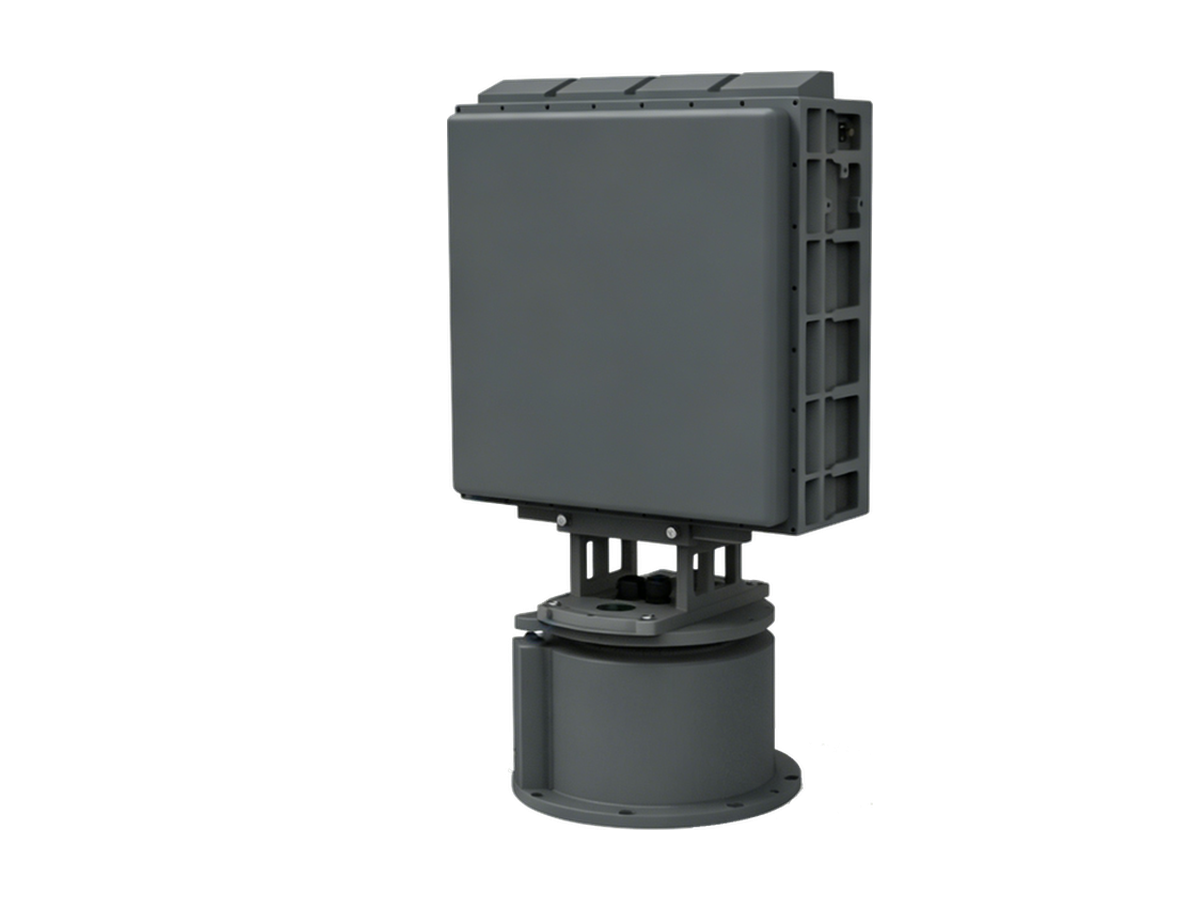
Need Counter-Drone Radar for Your Site?
CR series low-altitude surveillance radars detect RCS 0.01 m² drones at 3–10 km and classify targets by micro-Doppler — every track outputs with target class and confidence.