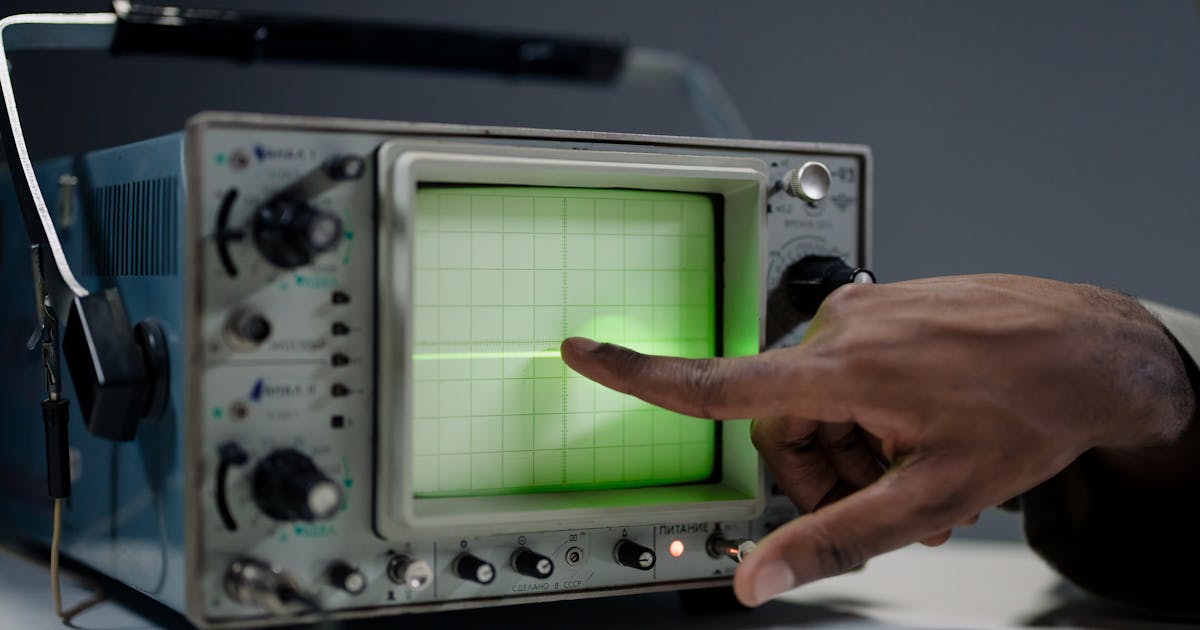
Waveform design affects small target detection because it controls how the radar spends time, energy, bandwidth, and processing attention. A small drone, bird-sized object, or low-RCS intruder may return only a weak echo. The radar cannot change the physics of that target, but it can choose how to illuminate the scene and how to extract useful information from the echo.
This is why two radars with similar antennas and similar headline range can behave differently in the field. One may update quickly but struggle to hold weak tracks. Another may integrate longer but react more slowly. One may separate nearby objects cleanly. Another may blend them together. The waveform is one of the design choices behind those differences.
Waveform Is Not a Magic Setting
A waveform is the transmitted signal pattern: its frequency, bandwidth, duration, repetition, modulation, and timing. In practice it is tied to the whole radar architecture. FMCW radars use chirps and beat-frequency processing. Pulse radars use transmitted bursts and receive windows. Pulse-Doppler radars add coherent processing across pulses to measure motion. Modern digital radars may schedule several waveform modes for search, confirmation, and tracking.
For small target detection, the important question is not whether one named waveform family is always better. The important question is whether the waveform fits the target, range, clutter, update-rate, and false-alarm requirements.
Energy And Dwell Time
Small targets need enough usable signal-to-noise ratio. Waveform design influences this through transmit duration, duty cycle, pulse repetition, coherent integration, and the time the radar dwells on a sector. More integration can make weak echoes easier to see, but it is not free. Longer dwell can reduce revisit rate, delay alarms, or leave less time for other sectors.
This trade-off is visible in counter-UAS missions. A radar watching a wide perimeter cannot stare forever at one direction. But if it scans too quickly with too little integration, the system may miss weak drones near clutter. A strong design uses waveform scheduling: broad search modes find candidates, then confirmation or track modes spend more processing effort where the target appears.
Bandwidth And Range Resolution
Bandwidth affects range resolution. Higher bandwidth can help separate two targets that are close in range, distinguish a drone from nearby clutter, and support more precise camera cueing. This is useful around buildings, cranes, fences, and tree lines, where a small target may appear close to stronger reflections.
However, high bandwidth also has design costs. It can require more capable radio-frequency hardware, wider receiver chains, more data throughput, and careful spectrum planning. In many countries the allowed operating band and emission mask are also part of the real design boundary. A waveform that looks attractive in a lab still has to fit local radio rules and site interference conditions.
Doppler And Micro-Motion
Small target detection is not only about seeing a dot. The radar must decide whether that dot behaves like a drone, bird, vehicle reflection, fan, or other object. Doppler processing is central because it reveals radial velocity. For rotors, propellers, and flapping wings, micro-Doppler can add useful clues.
Waveform design determines how Doppler is sampled and how much ambiguity the processor must resolve. Pulse repetition frequency, chirp repetition, coherent processing interval, and scan strategy all matter. If the waveform is not stable enough for coherent processing, or if the revisit time is too slow, the radar may detect a target but lose some of the motion features that help classify it.
Clutter Is Where Waveforms Prove Themselves
Open-field range numbers rarely tell the whole story. Small target detection is usually hardest near ground clutter, rain, sea clutter, vegetation, buildings, and moving vehicles. A waveform must work with filtering, CFAR detection, track logic, and classification algorithms to suppress clutter while preserving weak target returns.
For example, a low-flying drone crossing a rooftop edge may briefly appear beside a strong reflection. A hovering drone may have little radial velocity, making it harder to separate from slow clutter. A drone flying across the radar beam may produce a different Doppler signature from one flying directly toward the radar. Good waveform design anticipates these cases and gives the processor enough separable information.
What Buyers Should Ask
Procurement teams do not need to design the waveform themselves, but they should ask practical questions:
- What waveform modes are used for search, confirmation, and tracking?
- How does the radar balance integration time against update rate?
- What bandwidth and range resolution are available in the configured operating band?
- How are slow, hovering, and crossing targets handled?
- What happens in rain, birds, trees, road traffic, and building multipath?
- Can the radar export track confidence, Doppler clues, or cueing data to EO/IR cameras?
- Are field-test results tied to realistic target size, route, altitude, and clutter conditions?
These questions are more useful than asking for a single maximum detection range. A high-quality answer should connect waveform behavior to the actual site and mission.
Common Mistakes
One mistake is assuming that more bandwidth automatically solves small target detection. Resolution helps, but it does not replace sensitivity, integration, clutter handling, or track logic.
Another mistake is assuming that the fastest update rate is always best. A radar that updates quickly but cannot integrate enough energy may generate unstable tracks. The best update rate is the one that supports timely decisions while preserving detection quality.
A third mistake is treating FMCW, pulse, or pulse-Doppler as marketing labels. Each family can be implemented well or poorly. The field result depends on the complete design: antenna, transmitter, receiver, waveform, processing, calibration, installation, and operator workflow.
Practical Conclusion
Waveform design affects small target detection by shaping the radar’s measurement opportunity. It controls how energy is applied, how echoes are separated, how motion is sampled, and how clutter is rejected. For counter-UAS and low-altitude security projects, the best waveform is not the most impressive term on a datasheet. It is the waveform strategy that finds weak targets early, keeps tracks stable, supports verification, and performs in the real environment where the radar will operate.
References
- MIT Lincoln Laboratory, Radar: Introduction to Radar Systems: https://www.ll.mit.edu/outreach/web-based-course-radar-introduction-radar-systems
- NASA, Spectrum band designators and bandwidths: https://www.nasa.gov/general/what-are-the-spectrum-band-designators-and-bandwidths/
- Cyrentis, What is FMCW vs Pulse Radar: /knowledge-base/what-is-fmcw-vs-pulse-radar/
- Cyrentis, Why Small Drones Are Difficult to Detect by Radar: /knowledge-base/why-small-drones-are-difficult-to-detect-by-radar/