
“Phased array” appears on almost every counter-UAS radar datasheet. It describes an antenna architecture, not a performance number, and the word by itself says nothing about how fast the radar will actually refresh your air picture. This guide explains what a phased array physically is, why electronic beam steering changes the drone-detection problem specifically, and what a buyer should verify before paying the premium.
Electronic steering vs. mechanical scanning
A mechanically scanned radar points its beam by rotating the antenna; the beam goes wherever the antenna is physically pointing. To revisit a sector, it waits for the antenna to swing back, typically once per full rotation. If a new target pops up just after the beam has passed, it can go unseen for most of a scan cycle.
A phased array removes that constraint. The antenna is a flat grid of fixed radiating elements — hundreds to thousands of them, depending on the radar — each fed with a controlled signal. By progressively shifting the phase, equivalently the timing, of the signal from one element to the next, the transmitted wavefronts reinforce each other in one chosen direction and cancel in others. Change the phase progression and the beam points somewhere else. NOAA’s NSSL descriptions put it plainly: the antenna remains stationary while the beam is steered electronically, left-to-right and up-and-down.

Figure: Synthesized explainer showing how a fixed antenna face can steer the beam by changing element timing and phase across the array.
Two consequences follow:
- Beam repositioning is effectively instantaneous. Switching direction takes roughly the length of one transmission schedule — microseconds to milliseconds — versus seconds of mechanical rotation. There is no momentum, no settling time, and no wind loading to fight.
- The RF path has no moving parts. Nothing wears, sticks, or needs a servo loop in the antenna itself. Fixed multi-face designs, discussed below, have no rotating parts at all.
Why it matters for drone detection
Drones are among the hardest targets a surveillance radar routinely faces: tiny radar cross-section (often around 0.01 m²), low altitude, slow speed relative to ground clutter, and — increasingly — deployment in groups. Against that target set, detection range is only half the job. The other half is how often the radar revisits every point in its volume, and how many jobs it can run at the same time.
Update rate against small, fast targets. A drone flying 20 m/s (72 km/h) moves 20 meters between 1-second updates, and 80 meters between 4-second updates. A rotating radar that sweeps its volume every few seconds produces tracks that lag and jump and take several scans to confirm; a fast inbound can be nearly on top of a site before an operator trusts the plot. An electronically steered beam can revisit any sector on a sub-second schedule and spend extra dwell on a new contact to confirm it immediately. We break down what update rate and revisit time actually mean for drone-detection radar in this dedicated article.
Multi-target tracking. A mechanical radar divides its attention by rotation: every bearing gets one look per scan, whether or not it needs one. A phased array schedules its time more like an operating system — a volume search on a steady cadence, faster updates for confirmed threats, longer dwells for uncertain contacts. That distinction between track-while-scan and dedicated tracking is what lets an array hold hundreds of tracks without dropping search, instead of staring at one target and going blind everywhere else.
Serial vs. parallel detection. Older radar designs run detection, tracking, and recognition as a serial pipeline: search, detect, then swing back and stare to classify. That penalty is severe in counter-UAS work, because recognizing a drone — separating it from a bird through micro-Doppler rotor signatures — requires the beam to dwell on the target. A mechanically scanned radar that dwells to classify is, for those seconds, not scanning anything else. A phased array interleaves search, track updates, and classification dwells as parallel tasks; results feed back into the schedule — confirmed birds deprioritized, unknown contacts given more dwell. Our companion article on how counter-UAS radar recognizes drones explains the architecture in full.
Field of view: one face is not 360 degrees
This is the mistake buyers make most often. A single flat array does not see in every direction. Electronic steering works best near broadside; push the beam out toward the plane of the panel — beyond roughly ±45–60° — and the effective aperture shrinks, gain falls, and the beam broadens. Behind the panel, the array is simply blind.
Three engineering answers exist:
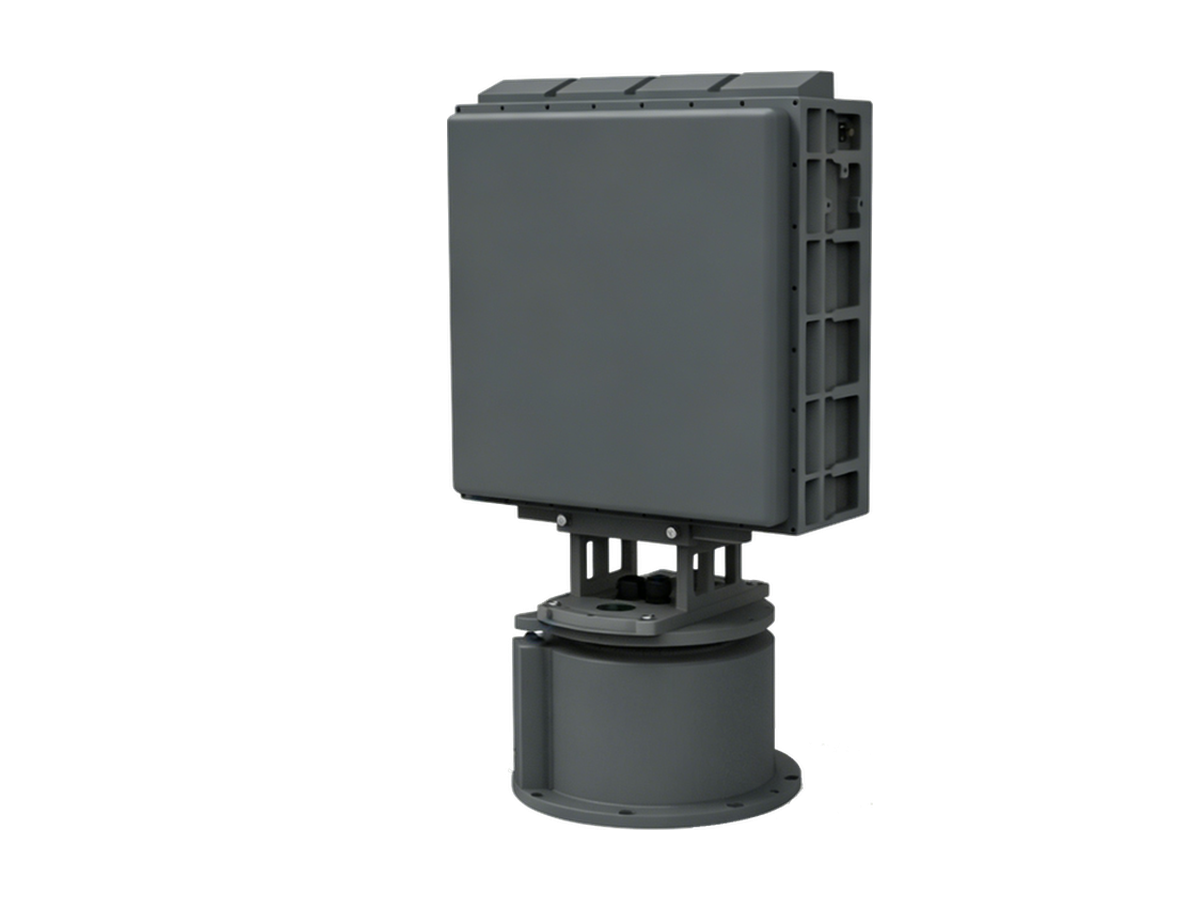
- One face on a turntable. The array rotates mechanically for 360° coverage. You get electronic steering within each sector at lower cost, but rotation reintroduces a revisit-time ceiling: the beam can only outrun its motor inside the sector currently in view.
- Fixed panels watching a defined sector — a fence line or approach corridor. Full electronic performance, deliberately limited angular responsibility.
- Four fixed faces. Four arrays mounted back-to-back cover 360° simultaneously with no mechanical scanning at all; every azimuth stays under continuous electronic control. The CR-PX11C is built this way — four fixed panels on an X-band pulse-Doppler array give instantaneous all-azimuth coverage. The cost is the obvious one: roughly four sets of electronics, channels, power, cooling, and calibration, plus a much larger structure.
“Phased array” and “360-degree coverage” are therefore independent claims. Always ask which of the three topologies you are being quoted.
Cost, maintenance, and the hidden dependency
Phased arrays buy reliability by deleting drive motors and rotary joints, then spend it on electronics: every element needs phase control, receive channels, and calibration, and a thousand-plus-channel array produces heat and drift. Four-faced systems multiply all of it. Field maintenance shifts from mechanical wear items — belts, encoders, servos — toward module replacement and periodic calibration. That is usually a better trade, but it is never zero maintenance.
The least visible dependency is software: electronic steering only delivers its agility if the beam scheduler actually interleaves search, tracking, and recognition intelligently under load. Two comparable arrays can behave very differently depending on that scheduler — which is why the architecture cannot be judged from the datasheet label.
Phased array is broader than AESA
One terminology trap is worth keeping. “Phased array” is the umbrella concept: any array that steers its beam electronically through phase control. PESA (passive) and AESA (active, with transmit/receive hardware distributed across the elements) are implementations within that family, and performance, cost, and fault tolerance differ between them. Saying “phased array” does not tell you which one is in the box. The full family tree, including how to interrogate an AESA claim, lives in our companion article: What is AESA Radar?.
What buyers should actually verify
Do not accept “phased array” or “instantaneous beam steering” as a specification. Ask for measured numbers, demonstrated under load:
- Update rate over the full declared search volume, in seconds — not the raw beam-switching speed of the hardware. One quiet-sky number is not enough; ask for the update rate while the radar holds 50 tracks, 100 tracks, and its full stated track capacity.
- Beam dwell per position, and how classification is paid for: does the search rate drop while the radar dwells for micro-Doppler — by how much?
- Track initiation time — the elapsed seconds from first echo to a confirmed, labeled track — for a small-RCS target inbound at speed.
- Topology and edge-of-face performance: one fixed face, turntable, or four faces; coverage and gain at the azimuth edges; exactly what happens at the seam between faces.
- Maintenance and calibration reality: service intervals, what drifts, whether modules are field-replaceable, and the true power and cooling budget.
Then confirm the key numbers in a live flight trial at the deployment site — small drones, flown in numbers — and write measured update rate and under-load track capacity into acceptance criteria. Graceful degradation under saturation is the difference between a fielded system and an empty-sky brochure number.
Bottom line
Phased array radar converts beam steering from a mechanical problem into an electronic one: the face stays still while the beam jumps to a new direction in microseconds. For counter-drone buyers that matters because it is the enabling condition for fast revisits, parallel search-track-classify operation, and high track capacity against targets that are small, fast, and numerous. It does not, by itself, guarantee any of those results — the number of faces, the quality of the scheduler, and measured behavior under load do that. Evaluate the architecture with a stopwatch and a swarm, not with the word printed on the datasheet.
Further Reading
Need Counter-Drone Radar for Your Site?
CR series low-altitude surveillance radars detect RCS 0.01 m² drones at 3–10 km and classify targets by micro-Doppler — every track outputs with target class and confidence.