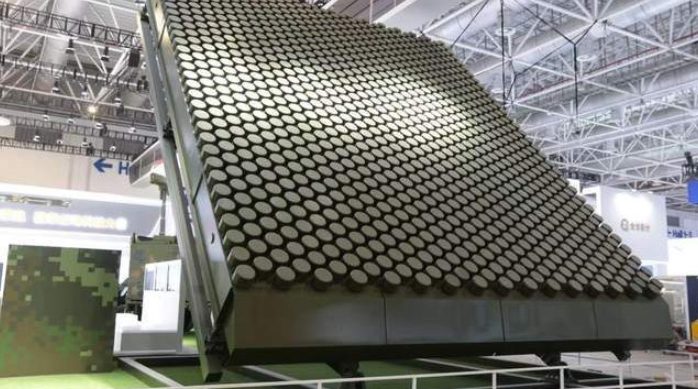
Defense was radar’s first application, and it remains the most heavily funded and technology-dense one to this day. Most of the other fields in this 16-part Radar Applications series can trace their origins back to military requirements spilling over into civilian life. But “military radar” is not one thing — it is a family strictly layered by mission, from space-object surveillance that sees farthest of all down to battlefield surveillance radars sitting at the edge of a trench, each doing its own job.
Warning and Early Warning: Seeing Far Comes First
The job of a long-range early-warning radar is to raise the alarm tens of minutes before ballistic missiles or bomber formations arrive. What it needs is power, aperture, and range — antennas meters or even tens of meters across and megawatt-class peak power are common, at the cost of enormous size and fixed sites. Airborne early warning puts this capability on an aircraft, trading altitude for horizon; looking down, it must pull low-flying targets out of strong ground clutter, which is the classic home of the pulse-Doppler architecture.
Air-defense search radars handle target detection and track assignment in the medium-altitude layer, where coverage and target capacity matter most. Low-altitude gap-filler radars specialize against aircraft and cruise missiles sneaking in at treetop height: attackers exploit terrain masking and the radar horizon, so gap fillers raise their antennas and push clutter down. The extreme case is over-the-horizon radar, which uses ionospheric reflection or high-frequency ground-wave diffraction to stretch the horizon to hundreds or even thousands of kilometers.
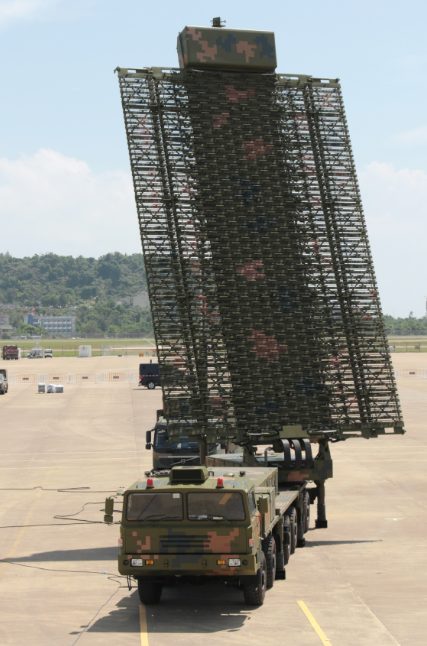
Figure: A large surveillance radar antenna built for long wavelengths. Long-range VHF/UHF surveillance radars double as counter-stealth assets — when the wavelength approaches the size of the target, radar-absorbent coatings and shaping optimized for centimeter waves lose much of their effect.
Counter-stealth radar has been a hot topic for two decades: stealth aircraft shaping and coatings are optimized mainly against high-frequency bands such as X-band, while the longer waves of VHF/UHF/L-band excite different scattering mechanisms that shrink the stealth advantage. The trade-off is poor angular resolution and massive antennas, so counter-stealth radars usually handle “alert and coarse location” and hand precise tracking to higher-frequency radars — multi-band cooperation is itself a system-level design.
Fire Control and Guidance: From “Seeing” to “Hitting”
Surveillance radars answer “is something there, and where”; fire-control radars answer “how do we hit it.” A fire-control radar tracks a single target continuously and precisely, outputting the range, angle, and velocity data needed to compute a firing solution. The monopulse technique compares amplitude and phase across multiple beams simultaneously, extracting angular error within a single pulse, and is the mainstream approach for precision tracking. Gun-laying radars shrink this down to company level, while the fire-control radar of a shipborne close-in weapon system must close the full loop — search, acquire, track, assess — within seconds.
Missile guidance comes in several layers. The illumination radar used with many surface-to-air missiles provides target illumination for semi-active seekers. An active radar seeker packs the entire transmit-receive system into the missile body and acquires the target autonomously in the terminal phase, letting the launch platform “fire and forget.” Counter-battery radar (weapon-locating radar) works the problem backward: it reconstructs an incoming shell’s trajectory and locates the enemy gun before the round even lands — it is trying to catch a palm-sized projectile in flight, which places extreme demands on small-target detection. Battlefield surveillance radar watches moving ground targets — vehicle columns, infiltrating soldiers — and its signature mode is GMTI.
Shipborne and Airborne: The Platform Defines the Form
Move the same mission to a different platform and the radar must be designed all over again. Shipborne phased array radars cover the entire sky with four fixed faces; a single radar handles search, track, missile guidance, and mid-course updates simultaneously, and the electronic scan speed of a phased array is something mechanical scanning can never match. The AESA active array goes further, distributing transmit-receive modules to every element for another step up in reliability and waveform flexibility. Airborne fire-control radars operate under brutal constraints on volume, weight, and power, which has driven sustained investment in gallium-nitride devices and digital arrays. Electronic support measures take the opposite path — they emit nothing at all, locating and identifying adversaries by listening to their radars, because stealth is their entire reason to exist.
Countermeasures Are the Eternal Theme
The biggest difference between military radar and the other fields in this series is that the adversary actively fights back. Barrage noise jamming, deceptive false targets, chaff and decoys, anti-radiation missiles — every radar must answer, in its design, the question “what happens when I’m jammed?” Frequency agility, sidelobe cancellation, ultra-low-sidelobe antennas, low-probability-of-intercept waveforms: this anti-jamming toolbox was essentially forged for military needs and only later spilled into civilian use. Understanding military radar is half about the physics of detection, and half about an offense-defense game that has been running for eighty years.
Closing Thoughts
The military radar family tree looks sprawling, but it has a single thread: the mission defines the radar. Warning needs range, search needs coverage, fire control needs precision, guidance needs speed, reconnaissance needs stealth — and each requirement, translated into engineering, becomes a choice of band, aperture, waveform, and platform. Once you see this layered logic, you can pick up any specific model and quickly read who it was born to serve.
Further Reading
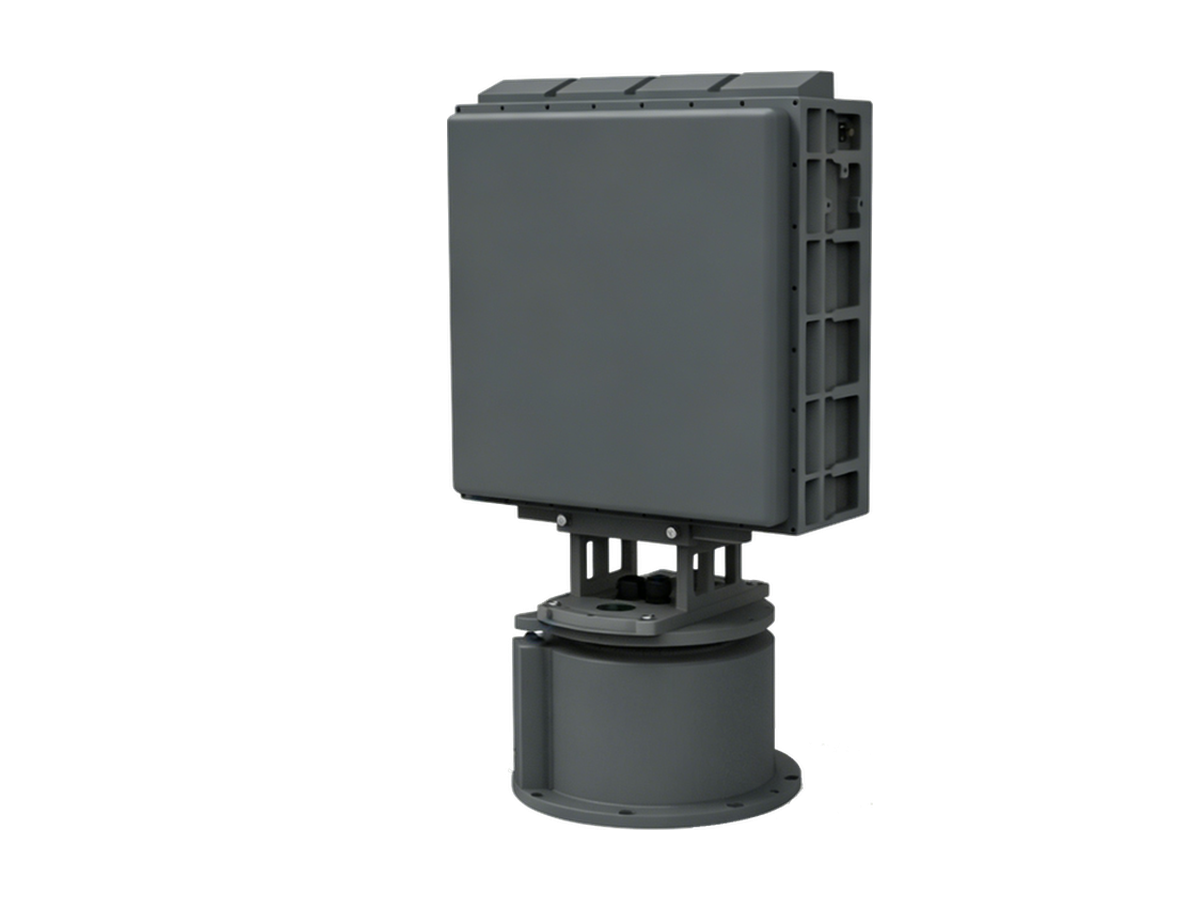
Need Counter-Drone Radar for Your Site?
CR series low-altitude surveillance radars detect RCS 0.01 m² drones at 3–10 km and classify targets by micro-Doppler — every track outputs with target class and confidence.