A product line of 22 counter-UAS radars is not a menu you pick from by intuition, and “which model should we buy?” is almost never answered by the biggest number on a datasheet. The right model falls out of four decisions, made in order: how far you must see, what shape the airspace around the site is, which frequency band fits the threat and the weather, and whether the radar lives on a pole forever or moves every week. (If you have not yet settled mission, target set, and integration needs, start with the broader framework in Choosing the Right Radar System.)
Get those four right and most of the 22 models eliminate themselves. This guide works through them in sequence, then maps every current Cyrentis model — short-range through the 10 km export-controlled class — onto a single table.
Step 1 — Start from the threat, the RCS, and the distance
Detection range only means something when it is attached to a target. All Cyrentis models quote drone detection range against an RCS 0.01 m² target — a small consumer quadcopter class — rather than against a large, cooperative aircraft. If you are new to why that number matters, start with what RCS 0.01 m² means and the detection range by RCS class breakdown.
Write down three distances before opening a catalog:
- Detect. The earliest range at which a 0.01 m² drone must appear on screen.
- Classify and confirm. Reliable bird/drone classification always happens closer in than raw detection — treat these as separate numbers, the way we explain in detection range vs. tracking range.
- React. Detection distance has to buy enough seconds for confirmation, intercept decision, and effect. A 1 km-radius venue needs only 1.5 km of radar range; an airport approach arc may need 8–10 km of standoff.
That maps directly onto four range tiers in the current lineup (all figures against RCS 0.01 m² UAV targets):
- Short range, 1.5–3 km — venues, campuses, small facilities, mobile teams.
- Medium range, 5 km — industrial sites, mid-size perimeters, airports’ inner rings.
- Long range, 8 km — airports, borders, coastal and wide-area infrastructure.
- 10 km class — the outer tier, and an export-controlled category (the model table below flags these models; see also the 10 km counter-UAS radar export explainer).
The geometry behind choosing the tier — why site diameter, reaction time, and line of sight, not price, set the range — is covered in our detection range selection guide and the short-range vs. long-range radar comparison. Remember that a drone below the rooftop horizon is invisible to every radar regardless of tier, so placement and line of sight decide whether a nominal 8 km radar delivers 8 km at your site.
Step 2 — Choose the coverage geometry: one rotating head, or four faces
The second decision is the shape of coverage. Cyrentis offers the same range tiers in two mechanical philosophies:
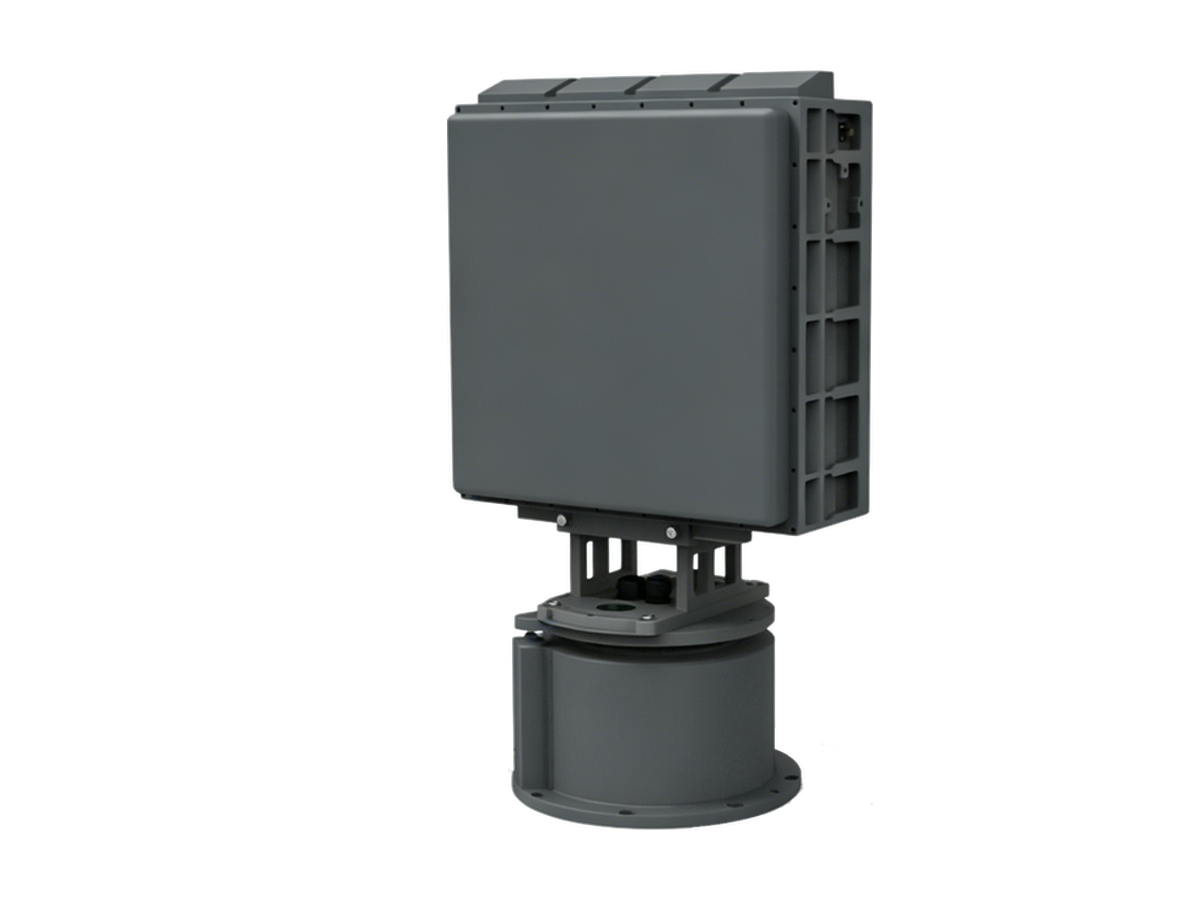
- Panel on turntable (model suffix B). One phased-array panel rotates for 360° mechanical scanning and can switch to 2D electronic scanning over a ±45° priority sector with no software change. One sensor, full azimuth, lower weight and power. While the head turns, any single bearing is revisited once per rotation — update rates of roughly 3–6 s depending on model.
- Four-faced array (model suffix C). Four fixed panels cover 360° simultaneously, with no mechanical scanning. Every bearing is watched all the time: TWS volume updates within 3–6 s plus TAS tracking of 24 targets with 0.5 s single-target updates. That is the difference between surveillance and continuous stare on a swarm crossing multiple bearings; the case for it is laid out in why multi-face radar suits 360° surveillance.
- FMCW turntable radars (FK/FX designations). A rotating panel with elevation digital beamforming and continuous-wave transmission — fast 2 s volume refresh, low emitted power, and lightweight deployment.
The trade-offs between rotating and staring architectures — dwell, revisit, and what happens to a maneuvering target on the far side of the rotation — are the subject of our radar scanning architectures comparison and the face-plus-turntable selection note.
One more geometry point: a bigger radar is not always the answer to a bigger site. Two or three medium-range heads at separate mast positions, or a network of nodes around a large perimeter, often beat a single long-range radar blocked by terrain and buildings. Multiple sites also give overlapping coverage and survive a single point of failure.
Step 3 — Pick the band: X or Ku
Every current model operates in X band (9.2–9.8 GHz) or Ku band (15.7–16.7 GHz); both are field-proven for small drones, and the full trade-off is covered in X band vs. Ku band for drone detection.
- Ku band uses a shorter wavelength, which yields finer angular resolution and richer micro-Doppler detail from small rotors. It is the natural choice when classification of very small targets at short-to-medium range is the priority.
- X band suffers slightly less atmospheric and rain attenuation, giving a margin in heavy-precipitation climates and at the longest ranges. For how weather actually degrades each band, see does rain and fog affect drone-detection radar.
If you are weighing lower bands as well, the C band vs. X band vs. Ku band comparison places all three on one page. For most buyers the decision is narrower: Ku for maximum small-target precision in dry-to-moderate climates, X for weather margin and the 8–10 km tiers — every 10 km model in the lineup is X band.
Step 4 — Fixed installation, mobile use, and sensor integration
The fourth decision is how the radar will live. A permanent rooftop or tower installation favors four-faced arrays: set-and-forget, no rotating servo, continuous coverage. Mobile and temporary deployments favor the light turntable and FMCW units — the CR-PX10B is under 17 kg, the CR-FK02 complete system under 25.5 kg, and the CR-FX10 under 30 kg including its pedestal, all tripod-deployable with self-leveling and north-finding. The fixed-versus-mobile trade-offs are summarized in fixed radar vs. mobile radar systems.
Radar is also only one layer. Sites that also need drone-link early warning and pilot geolocation add passive RF; sites that need visual evidence and classification confirmation add EO/IR cameras cued by the radar. When radar is the primary sensor and what each layer adds is mapped in counter-UAS radar vs. RF detection, radar and EO/IR working together, and the end-to-end drone detection system design guide.
Model mapping table: all 22 current models
All ranges below are drone detection ranges against RCS 0.01 m². “Turntable” means one rotating panel with mechanical 360° plus electronic sector scan; “four-faced” means simultaneous 360° with no mechanical scanning; “FMCW turntable” means low-power continuous-wave with elevation DBF and a ~2 s refresh.
| Range tier | Coverage geometry | Models | Typical site |
|---|---|---|---|
| Short, ≥1.5 km (X) | Turntable / four-faced | CR-PX10B (1.5 km) · CR-PX10C (1.5 km, four-faced) | Event venues, campuses, smallest perimeters, rapid reaction teams |
| Short, ≥2 km (Ku) | FMCW turntable | CR-FK02 (2 km, 25.5 kg, air–ground–surface) | Lightweight mobile deployment, low-probability-of-intercept operation |
| Short, ≥3 km (Ku) | Turntable / four-faced | CR-PK13B (3 km) · CR-PK13C (3 km, four-faced) | Ku precision at short range: venues, airports, mobile C-UAS |
| Short, ≥3 km (X) | Turntable / four-faced | CR-PX15B (3 km) · CR-PX15C (3 km, four-faced) | Fixed facilities and urban sites wanting weather margin at 3 km |
| Medium, ≥5 km (Ku) | Turntable / four-faced | CR-PK05B (5 km) · CR-PK05C (5 km, four-faced) | Industrial perimeters, airport inner zones, critical infrastructure |
| Medium, ≥5 km (X) | Turntable / four-faced | CR-PX07B (5 km) · CR-PX07C (5 km, four-faced) | All-weather 5 km nodes, multi-site networks, coastal sites |
| Medium, ≥5 km (X) | FMCW turntable | CR-FX10 (5 km, 10 km instrumented, 200 tracks) | Rapid-deploy 5 km monitoring, low-emission urban operation |
| Long, ≥8 km (X) | Turntable / four-faced | CR-PX08B (8 km) · CR-PX08C (8 km, four-faced) | Airports, large industrial and wide-area perimeter arcs |
| Long, ≥8 km (X, large-aperture digital array) | Turntable / four-faced | CR-PX16B (8 km, 576-channel array) · CR-PX16C (8 km, four-faced) | Wide-area surveillance and C-UAS command-and-control networks |
| Long, ≥8 km (Ku, large-aperture digital array) | Turntable / four-faced | CR-PK14B (8 km, 1024-channel array) · CR-PK14C (8 km, four-faced) | Border and large-site coverage where Ku precision at range matters |
| 10 km class, ≥10 km (X), export-controlled | FMCW turntable | CR-FX18 (10 km, 20 km instrumented, 500 tracks) · CR-FX20 (10 km, 20 km instrumented) | Wide-area, low-intercept surveillance; subject to dual-use export authorization |
| 10 km class, ≥10 km (X), export-controlled | Turntable / four-faced | CR-PX11B (10 km) · CR-PX11C (10 km, 1536-channel four-faced) | Highest-tier fixed wide-area nodes and long perimeters; export license required |
The B-vs-C choice repeats at every tier: buy the turntable when one sensor must cover full azimuth at weight and power limits, or when deployment moves; buy the four-faced C model when the site needs simultaneous, uninterrupted 360° coverage with fast TAS updates on multiple targets.
Three worked selections
1 km urban venue, one major event. Reaction geometry is short and the threat can appear from any bearing over rooftops. A short-range tier suffices; the question is stare vs. sweep. A fixed venue with a mast position chooses the four-faced CR-PX10C or, for finer Ku micro-Doppler at 3 km, the CR-PK13C. A mobile team setting up the morning of the event takes the 17 kg CR-PX10B or the FMCW CR-FK02.
5 km industrial perimeter with two gates and a fence line. The perimeter has preferred approach corridors, so one 5 km turntable radar per sector covers more ground than one central sensor trying to see through plant structures. A pair of CR-PK05B units (Ku precision on the approach lanes) or all-weather CR-PX07B units on opposite sides is the standard answer; a single central CR-PK05C or CR-PX07C suits a clear, unobstructed site that wants one fixed node. A temporary project office or touring requirement adds a CR-FX10 instead of a permanent mast.
8–10 km airport or coastal arc. An approach path or shoreline is a known sector, which a turntable radar can stare at electronically while still sweeping the rest of the sky: the CR-PX08B, the large-aperture CR-PX16B, or the Ku CR-PK14B for the finest long-range accuracy. Full-perimeter installations take the matching four-faced CR-PX08C, CR-PX16C, or CR-PK14C. If the standoff requirement genuinely reaches 10 km, the FMCW CR-FX18/CR-FX20 or the CR-PX11B/CR-PX11C apply — budget export-licensing lead time, since 10 km-class counter-UAS radar is dual-use controlled.
Buyer beware: brochure numbers vs. acceptance criteria
A range figure without conditions is a marketing figure. Whatever model you shortlist, put these in the tender and the site acceptance test: target RCS (0.01 m² class), probability of detection, false-alarm rate, update/revisit rate, tracking range, and classification range measured separately, in your environment, in your weather. Require a live flight trial with representative drones — vendor demo footage is shot where the vendor chose. The exact language belongs in your requirements document; our guide to writing better detection-range requirements in tenders provides the clause structure.
Closing
The model is the output, not the starting point: threat and distance set the tier, site geometry sets the face count, climate and target size set the band, and deployment style sets the form factor. Work those four decisions and the 22-model catalog collapses to a short list of two or three. Full specifications for every model above are on the product pages, and our engineering team can review your site layout and recommend a configuration — send the site dimensions, the threat scenario, and the available mast positions through the inquiry form.
Need Counter-Drone Radar for Your Site?
CR series low-altitude surveillance radars detect RCS 0.01 m² drones at 3–10 km and classify targets by micro-Doppler — every track outputs with target class and confidence.