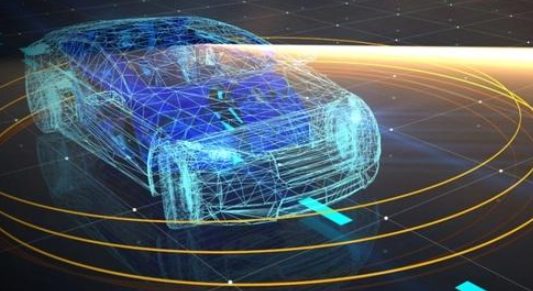
In the landscape of this 16-part Radar Applications series, automotive is the liveliest market right now — annual shipments in the hundreds of millions, and the highest-frequency radar an ordinary person can actually buy. Automatic emergency braking (AEB), adaptive cruise control, blind-spot monitoring: behind all of them sits the same thing, a millimeter-wave radar working at 76–81 GHz.
Why 76–81 GHz
Early automotive radars used 24 GHz; regulators and industry worldwide then moved almost in lockstep to 76–81 GHz, and the physics is straightforward. The wavelength is about 4 millimeters, so antennas can be made tiny — hiding them behind the emblem or bumper is trivial. At the same time the available bandwidth of 4–5 GHz delivers range resolution in the centimeter-to-decimeter class: separating two cars driving abreast in one lane, or telling a guardrail from a stalled vehicle, is exactly what that bandwidth buys. The application lists standards bodies such as ETSI have drawn up for this band read like today’s driver-assistance catalog: obstacle detection, Stop&Go, blind-spot detection, park assist, pre-collision.
The Technical Foundation: FMCW Plus MIMO
Automotive radar is almost uniformly FMCW: transmit a long signal whose frequency ramps linearly, mix the echo with the local oscillator, and out comes a “beat frequency” — range hides in the beat frequency, velocity in how the beat signal’s phase changes over time. One measurement yields range and velocity together, at low transmit power, which is decisive in a cost- and power-sensitive automotive-grade environment. In the comparison with pulse radar, FMCW’s weaknesses — transmit-receive isolation and a near-range blind zone — happen to be non-fatal in automotive scenarios.
Angle measurement relies on the MIMO virtual array: a handful of transmit and receive antennas combine into an equivalent aperture of tens or hundreds of virtual elements, so angular resolution is no longer hostage to physical antenna size. MIMO has been pushed to its limit on automotive chips — single-chip radar integration now packs even the antenna-in-package into a module a few centimeters across.
Division of Labor by Position: Front, Corner, and 4D Imaging
The radars on a car have distinct jobs. The long-range front radar looks 150–250 meters ahead with a narrow field of view and high gain, serving adaptive cruise and AEB. Corner radars sit at the four bumper corners with wide fields of view and short range, covering blind-spot monitoring, lane-change assist, and rear cross-traffic alert; for parking, ultra-short-range radar is taking over the job ultrasonics used to do. Safety ratings such as Euro NCAP grade AEB performance with repeatable standard targets (simulated pedestrians, cyclists, motorcyclists), which has directly fueled an arms race in vulnerable road user detection.
4D imaging radar is the newest step. A conventional automotive radar outputs three dimensions — range, velocity, azimuth; 4D imaging radar cascades chips to push virtual channel counts into the thousands and adds “elevation,” with point-cloud density approaching that of low-channel lidar. Whether the system can tell “an overpass sign you can drive under” from “a stalled truck you must brake for” depends on exactly this dimension. Its relationship with lidar is division of labor, not replacement — the radar versus lidar comparison always lands on radar’s side in rain, fog, and glare.
From Outside to Inside: In-Cabin Sensing
Millimeter wave is also moving into the cabin, and the clearest production direction is child presence detection (CPD): a closed cabin in summer heat can turn lethal within twenty minutes, and CPD judges from the tiny chest movements of breathing whether a child has been left in the back seat — electromagnetic waves pass straight through blankets and sunshades, and a multi-transmit multi-receive virtual array pulls the whole cabin, footwells included, into the detection zone. On the technology map, seat pressure sensors cannot tell an occupied child seat from an empty strapped-in one, and in-cabin cameras have blind spots plus privacy controversy; millimeter wave outputs only point tracks, never images, which patches both gaps. Euro NCAP has folded CPD into its rating, scoring direct detection (which senses vital signs) above indirect detection — in-cabin radar is moving from bonus feature to entry requirement.
The same hardware keeps growing new functions: occupant classification linked to airbag deployment strategy, seat-occupancy detection for belt reminders, intrusion alerts after locking, driver breathing and heart-rate trend tracking, plus touchless gesture interaction — in essence, packing micro-Doppler and micro-motion detection into an automotive-grade chip. Exterior sensing handles “don’t crash,” interior sensing handles “don’t leave anyone behind,” and one technical foundation covers the safety of the whole vehicle.
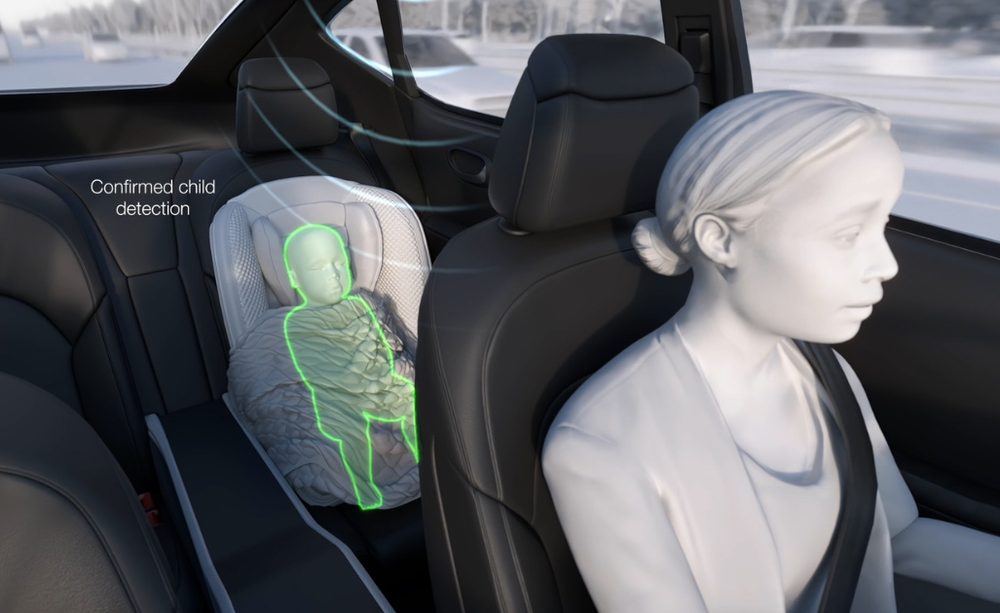
Figure: Child presence detection (CPD) by in-cabin radar — confirming from breathing and micro-motion whether a child has been left in the back seat.
Closing Thoughts
Automotive radar’s evolution is the best example of “scenarios forcing technology”: bumper thickness fixed the band, AEB braking distance fixed the range, and the cost red line fixed the single-chip solution — every constraint became a design parameter. Two threads are worth watching next: whether 4D imaging can carry the weight of a primary sensor, and whether in-cabin sensing becomes the next standard fit. For the ordinary consumer, one line is enough: the only active-safety sensor that still works steadily in rain, fog, and darkness is millimeter-wave radar.
Further Reading
Need Counter-Drone Radar for Your Site?
CR series low-altitude surveillance radars detect RCS 0.01 m² drones at 3–10 km and classify targets by micro-Doppler — every track outputs with target class and confidence.